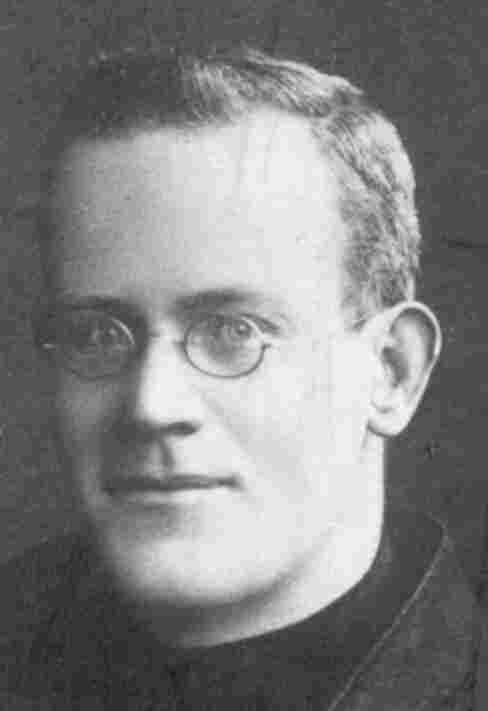
Fr. Richard Curran C.P. WITH deep regret we chronicle the death of Father Richard. (Curran), C.P., which occurred at Holy Cross Retreat, Ardoyne, Belfast, on Wednesday, April 12th. For some time past he had been in failing health, but quite recently he had so far recovered as to give hopes that many years of life still remained to him. But Providence had decreed otherwise; he was again stricken down, and it was quickly obvious that the end was at hand. He received the Last Sacraments with edifying sentiments of resignation to God’s Will, and at the comparatively early age of fifty-eight he peacefully passed to his reward. Born in Mountmellick on July 31st, 1880, James Curran, as he was then known, came of a family which has given many members to the religious state. Two of his brothers are Redemptorists, Rev. Michael Curran, C.SS.R. and Rev. Joseph Curran, C.SS.R.; another brother, Rev. Stanislaus Curran, C.P. died in1918; whilst two of his sisters are nuns, Rev. Mother Benigna, C.P., Batley Carr, and Rev. Mother Vincent, Loreto Convent, Kilkenny. These numerous vocations are tangible evidence of the strong religious sentiments which surrounded his youth. He entered the Passionist Congregation at Broadway, Worcestershire, in 1901, taking the name of Richard of the Seven Dolours. After his profession, he was sent to the Mother-house of the Passionist Congregation, SS. John and Paul’s, Rome, where he completed his ecclesiastical studies and was raised to the priesthood in October, 1905. On his return to his own Province, he filled many various positions with distinction, and for some years was engaged as Lector at Carmarthen and in Dublin. His ability was recognised by his colleagues, when in 1920, he was elected Rector of St. Paul’s Retreat, Mount Argus, Dublin. At the subsequent chapter, he was chosen Rector of Holy Cross Retreat, Ardoyne, Belfast (1923-26); and the remainder of his priestly life was spent in that city. It is as a noted preacher and missioner that Fr. Richard will best be remembered. His sojourn at SS. John and Paul’s had filled him with a deep and abiding Passionist spirit; for him the ideals of St. Paul of the Cross were active and vital realities, and he modelled his missionary life upon the example of the Founder of the Passionists. A forceful and impressive preacher, he did not trust to the power of eloquence alone; earnestness and zeal were to him of even more importance than the form of the spoken word. This earnestness, this truly apostolic spirit, were marvellously effective in ensuring the success of his protracted missionary labours. Those who listened to him felt that here was one who had their spiritual interest at heart. They hearkened to his words and found confidence in his exhortations; whilst the endless crowds kneeling patiently outside his confessional-box were tangible evidence that he had won the hearts of his congregation and had deeply moved their souls to contrition and repentance. When the fire of youth had departed with the passing of the years, Fr. Richard still devoted himself indefatigably to the missions. It was his frequent task to supervise the early missionary labours of many of the younger priests, and for him this was indeed an acceptable task. Again and again he stressed the need for emphasising the distinctive Passionist spirit on the missions; he sustained and directed the zeal of his companions; with gentle tact and cheerful words of exhortation he encouraged them to develop their missionary talents and to maintain the highest standards in this specialised field of apostolic work. The late Fr. Richard was to many, both within and without the Congregation, the realisation of the ideal Passionist. His spirit of prayer was profound without being obtrusive; but few who knew him well could fail to notice his careful preparation and his long thanksgiving after the celebration of Holy Mass. The well-worn condition of the little manuals of piety which were his constant companions speak eloquently of his unaffected devotion. With his brethren in the community he was ever a cheerful and affable companion; his gaiety was infectious, and his hearty greeting bespoke the warmth of his own feelings. By all those who knew him he was held in the highest esteem; he was frequently consulted by the clergy, whilst his renown as a sympathetic and helpful confessor was widespread amongst the laity. Many will feel that by his passing they have lost one who was, in a very real sense, the father and friend of their soul. May he rest in peace. (The Cross, Vol. XXX, 1939-40; p.43)