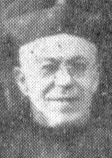
Fr. Placid (Stevens), C.P. THE English Province of the Passionists has suffered a severe loss by the death of Fr. Placid of the Holy Family, which occurred at St. Anne’s Retreat, Sutton, Lancs., on February 8th, 1941. A native of the Netherlands, the late Fr. Placid was born at Baarlo in the Diocese of Roermund on May 19th, 1879. Known in the world as John Hubert Stevens, he entered the Passionist Congregation at the early age of fifteen years and was ordained in December, 1903. For some time he acted as Lector at SS. John and Paul’s, Rome, where he had amongst his students His Excellency Leo P. Kierkels, C.P., Apostolic Delegate to India. Specialising in Sacred Scripture, he spent nearly six years in Palestine familiarising himself with conditions and customs in the Holy Land. The results of his observations and experiences appeared in a series of articles entitled “In the Land of the Bible” which Fr.. Placid contributed to The Cross. DURING the Great War, Fr. Placid came to St. Joseph’s Province to provide spiritual assistance for the numerous refugees who had flocked to London from the Continent. An able linguist, an accomplished musician, Fr. Placid was a. religious of outstanding worth. He endeared himself to all by his affable manner and amiable disposition. Especially was he esteemed by the parishioners of Highgate, where he had laboured for many years. During this period he also acted as chaplain to St. Aloysius’s College, Highgate, where he took a keen interest in the pupils. For some time past Fr. Placid had laboured under indifferent health. It was hoped that relief from more onerous duties might help to restore his strength, but he himself seemed to realise that his labours were approaching the end. By his death the Passionist Congregation has lost one of its most loyal and most devoted sons. R. I. P. (The Cross, Vol. XXXI, 1940-41; p.496) FATHER PLACID STEVENS, C.P. In the death of Fr. Placid, the Province of St. Joseph, has suffered a most grievous loss. In his case, this is no mere hackneyed phrase, but is literally true. For Fr Placid was more than a good religious – though even that is great praise -he was a scholar, and a priest of holy life, well beyond the ordinary, and his passing has left a real gap in our ranks. John Hubert Stevens — fort that was his name in the world – son of Alphonsus and Gertrude Stevens, was born at Barlo, Holland, on May 19, 1879. Unfortunately, of his childhood years, we have few details, and conjecture is not biography. But there are exceptions, and one is sure that a boy who entered the Passionist Alumniate at the age of 12 years, and passed, later on, after the unanimous vote of his masters, to the Novitiate, must have shown early signs of a religious vocation and solid virtue. The words of Ecclesiasticus (Chap.25,5) had clearly no application to young Hubert Stevens: “The things that thou hast not gathered in thy youth, how shalt thou find them in thine old age? Confratrer Placid, (as he now was)was professed on June 10, 1895. Six years later, i.e., on December 21 1901 he was ordained priest, by a special dispensation, for he was not yet 23. At this stage of his religious life, conjecture again becomes lawful, for he gave such proof of solid virtue and general capacity that he was made rector when only 28 years old, and proceeded to build the fine church and Passionist retreat in Mook. my. He had certainly, “gathered” much in his youth to be capable of such an achievement before he was 30. Details of this period of his life are annoyingly scarce but he seems to have spent several years in the Holy Land at our Bethany Retreat, where he put her crown on his already considerable decrees of scholarship, and acquired that profound knowledge of the East — its people, manners and customs — which bore such interesting fruit, years later, in a long series of articles in The Cross. Father Placid who already knew Greek and Hebrew, added a Arabic to his list of languages at this time. The result of all these studies was a profound biblical knowledge, and it should be known that Father Placid, while in the Holy Land, earned the friendship and appreciation of Pere Lagrange, the greatest Catholic scripture scholar of our time. Towards conclusion of the war of 1914-1918, Father Placid, now a consultant of the congregation. came to St Joseph’s Retreat, Highgate Hill, to act as interpreter, and be n general church of the many Dutch and Belgian refugees who were in England at the time, and who were most appreciative of his presence among them. To the English folk, amongst whom he moved in those London years, he was most endeared, and won their hearts by the loveableness and spiritual beauty of this character. He stood the supreme test of living with others in community for he was loved and appreciated, even more, at home in the retreat than without. After the London period he taught our students in Rome for some years, but once again returned to Highgate to resume his work there. Subsequently we find him at St Anne’s Retreat, Sutton, where he was director of the children of Mary, and had charge of the church choir. This was from 1928 to 1933. He then returned to Highgate for a time, from which he was next transferred to Broadway, Worcs., and a year ago he returned to Sutton – “last scene of all” – where he was engaged in teaching a newly professed class of students at the time of his death, which took place on February 8th., as the sad result of an accident in the “black-out”. About a week before his death he was out one afternoon in the parish and started, without an electric torch, to return to the retreat in time for supper, when night had already fallen,. He seems, sad to relate, to have fallen over an embankment, near the retreat, on the pavement and his injuries were terrible. One of the community happened, providentially, to pass a few minutes later, and found him. He was removed to hospital by ambulance and received Extreme Unction at the hands of Father Rector, who stayed with him till a late hour. From the first case was hopeless, and he passed peacefully away at 7:50 a.m. on Saturday February 8th. It has been said that Father Placid was not merely a good religious, but and man of holy life. His day was not passed in mere external conformity to rules and regulations, but was informed and made a vital and meritorious by interior union with his divine Master. Space forbids an extended picture of that union in its outward manifestations, but we must note two points, which were crystal clear to all — his humility and great charity. It was well nigh impossible to make him talk about himself, his attainments, his doings. Hence the difficulty one experiences, in writing the obituary notice of such a man, and true religious. We might have known him for years and not be aware of, for example, that he was an oriental scholar, and well acquainted with the principal languages of Europe. He was selfless, and inconsiderate of his own comfort to a degree, and rare indeed where the occasions when anything like a complaint came from his lips. His spirit of charity would deserve separate treatment, if we were to do it and anything like justice. here it must be enough to say that he was never known to utter a single unkind word about anyone, inside or outside the retreat. . About his accomplishments in the order of nature, much might be said in addition to the above. He was an expert in the music of the church in general (plainchant in particular) and he was a skilled organist. In matters literary, he had a marked gift for versification and could turn out very reasonable verses at a moments notice. Sometimes these verses were skilfully woven together, and became poetry. Perhaps his best effort of recent years was his hymn to St Gemma, and two of its verses may being this “Notice” fittingly to an end, and tell us also the secret of Father Placid’s own spiritual life and childlike simplicity of heart: “Brief thy career, but rich in fruits Of everlasting life. \How radiant is thy crown of bliss As ended is thy strife, Dear Gemma, may thy beauteous light Blind us to things of earth, And draw our eyes and hearts to God And things of lasting worth” Fr. Placid lived for a things of “lasting worth”, so it is with no misgivings that we pray, “may his dear soul rest in peace”.