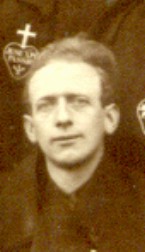
OBITUARY FATHER PIUS (CAROLAN), C.P. (d. 7th March 1930, aged 35 years.) On March 7th, Father Pius of St. Gabriel (known in the world as Thomas (Carolan), passed to his reward, after almost a year’s illness, at the early age of 35 years He was born in Bailieboro’, Co. Cavan, on July 14th, 1894; made his profession in the Passionist Congregation at St. Gabriel’s Retreat, Enniskillen, on 2nd November, 1914; studied philosophy and theology at St. Paul’s Retreat, Mount Argus, and St. Anne’s Retreat, Sutton, Lancs., and was ordained priest on February 28th, 1920, by the late Archbishop Whiteside of Liverpool. During his stay in Lancashire, Father Pius gave missions, retreats, preached charity sermons and was a tower of strength to the Catholic Evidence Guild, which is such a potent factor in spreading the light of Faith in England. But his most important and equally arduous work was the teaching of philosophy and sacred theology to a class of students then resident at St. Anne’s Retreat a work which he ably and wholeheartedly accomplished. Labour of such varied nature obviously demanded abundant self-sacrifice on his part, but in his zeal and enthusiasm he was ever ready and cheerfully responded to the many calls for his services in the North of England. A fluent Gaelic speaker, he rendered signal service to the language movement amongst his compatriots, and his work received grateful recognition by his appointment as President of the Liverpool Gaelic League. On his return to Ireland he became a member of the Community at St. Gabriel’s Retreat, Enniskillen, and, until his health failed, was constantly engaged in missionary work in Ireland. His last appearance in the pulpit was when he conducted a Triduum for the Confraternities of Dublin, in the Pro-Cathedral. Father Pius was a priest of great promise, and his intellectual attainments in the domain of philosophy, theology, social science and literature, well equipped him for the work of the Ministry. He passionately devoted himself to the study of the works of St. Thomas, and the wealth of knowledge which he derived from the Angelic Doctor imparted a cogency and solidity to his discourses that were well calculated to impress his hearers and carry conviction. Having in view the trend of his reading, we need not wonder that his favourite themes were the Blessed Sacrament and the Holy Sacrifice of the Mass. He specialised in spreading devotion to the Holy Eucharist. A clear and intimate knowledge of the doctrine and liturgy relating to this great Mystery of Love enabled him to create such an impression on the minds of his hearers that their hearts burned within them, and they became imbued with the same spirit of profound adoration and sense of gratitude. ” Out of the abundance of the heart the mouth speaketh, ‘ and thus it is not surprising to learn that his own devotion to the Holy Mass was something quite extraordinary. He never wearied speaking of the Mass, in which, with a vivid perception of its tremendous spiritual content, he recognised the great means used by God to draw the world to Himself. To his intensely Passionist heart, the identity between the Mass and the Passion was an additional motive, wherein he found fresh fuel to feed the fire of his devotion; and it is surely fitting that amongst the memorials of his life’s work is a sermon on ” The Mass” in the volume ” Catholic Preachers of To-day.” Those who are devoted to the love and service of God are not infrequently the recipients of special favours, and it is a striking coincidence that the death of Father Pius should occur on the Feast of St. Thomas, of whom he was such a devoted client. He fulfilled his obligation of promoting devotion to the Sacred Passion with a fervour which showed his own love for the Sufferings of Christ Crucified, and he spoke with such feeling of Him “Who was wounded for our iniquities and bruised for our sins ” as to enkindle the fire of Divine Love in the hearts of those who were privileged to hear him. The large numbers who flocked to his confessional indicated that he was not wanting in this work of mercy as dispenser of the mysteries of God. We can wed understand his kindness and gentleness, combined with painstaking zeal, in the Sacred Tribunal. Like our Divine Master, be ” would not break the bruised reed or quench the smoking flax.” Around the open grave, in the quiet cemetery of Mount Argus, on the day of he obsequies, the poignant sorrow of clergy and people was manifest. The prayers of thousands, no doubt, have been and will be offered for the happy repose of the soul of this young Passionist whose personal sanctity and rare gifts adorned the religious state and the priestly life. C T. (ex. “The Cross”, April 1930, Vol. XX, p. 441)