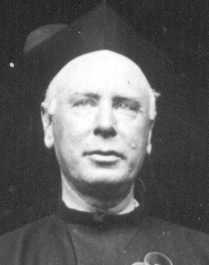
OBITUARY NOTICE OF FR. MICHAEL WATTS-RUSSELL C.P. On the 20th March our Province sustained a severe loss, and all hearts were saddened by the death of Fr. Michael of the Sacred Heart of Mary. Fr. Michael was born in the Eternal City on February 11th, 1848, and was baptised in the Church of Sant’ Andrea delle Fratte, receiving at the sacred font the name of John Chrysostom. His father, Michael Watts-Russell – the lifelong and intimate friend of Fr. Faber – had, late in 1845, resigned his “living” of Benefield, in the Anglican Church, and become a Catholic — hence the family lived for the most part abroad. His mother was a woman of singular sweetness of disposition and deep piety; the picture of her and her two little girls dining and waiting on four poor men, at Lucca, every Thursday, is like a passage from the life of some medieval saint. She died November 11, 1851. Fr. Michael was the second of their three sons, his brothers being Wilfrid and Julian. In brief visits to England, the boys were frequent visitors to Fr. Faber at the London Oratory, and guests of the Oratorian Fathers at their country house, Sydenham. Fr. Michael’s earliest education was received from tutors who travelled with the family; but, in 1857 he was with his brothers at the Collegio Nobili, Rome, for two months. In the summer of that year the family went to Venice, where, with Julian, he received the Sacrament of Confirmation on the third Sunday of September. A priest, Don Joseph Calderan, who was their godfather on the occasion, wrote of it afterwards:- “What thoughtfulness! What fervent prayer! I really imagined myself to be between two angels at that function which the Patriarch Ramazotti performed at the Church of the Pianto.” In 1861 the three brothers went to Ushaw; though their stay was brief, only eighteen months, Fr. Michael-ever afterwards spoke of Ushaw with admiration and affection as his “Alma Mater.” The next three years and a half were spent in Italy and France, with some travelling in Corsica and Germany. For some time the singular project was entertained of the whole family migrating to Australia. Brisbane was selected-where to aid the rising church the boys would become missionary priests and the girls establish a community of Carmelite nuns. This was, however, abandoned through legal and family difficulties. His two brothers then chose a military career, and, through a relative, sought for commissions in the Austrian army. As these could not be obtained without renouncing their nationality, they afterwards enlisted as private soldiers in the Papal Zouaves to aid in defending the Patrimony of St. Peter against the Italian revolution then threatening it. In the meantime Fr. Michael had felt himself called to the religious life, and had chosen the Congregation of the Passion. The family residence, llam Hall, in beautiful Dovedall, Derbyshire, at this time occupied by his grandfather, is not far from St. Wilfrid’s, Cotton, where Fr. Faber had established his first community, and where also our Fathers had for a time a Retreat. There the family assembled in the autumn of 1866 to bid John god-speed. The day before he left home he had a very narrow escape of his life. His brothers in fun had taken down two old muskets hanging in the hall and had put caps on them to startle him with the noise; as he crossed the hall they took deliberate aim and fired ; one of the muskets was loaded, and the ball passed close to his head; his escape he ever attributed to the special protection of Our Lady. It was on the feast of St. Michael, 1866, he said good-bye to his family and came to Broadway. This and the fact that Michael was his father’s name induced him to ask for the name of Michael in religion. He received the habit on the 15th October, St. Teresa’s day- another family devotion. He was now eighteen and a half years old, a fair-haired, outspoken English boy, overflowing with good spirits and fond of all outdoor sports, a strong swimmer and a splendid shot – the gates his companions climbed over he always vaulted, the ditches they scrambled through he always jumped. But under all were the deepest and simplest piety, and the most affectionate and trustful devotion to Our Blessed Lady. He made his religious profession on October 16th, 1867, but remained another month in the novitiate, waiting for the profession of a companion, with whom he travelled to Sutton on November 14, and on the following day to St. Paul’s, Dublin, to commence his ecclesiastical studies. His first days in Dublin were saddened by the news-known at Broadway the day before he left, but kindly withheld from him – of his brother Julian’s death on the battlefield of Mentana, November 3rd. Those with him at the time remarked how with his sorrow, there showed itself a noble pride that he had had a brother who had shed his blood for the Church. At Mount Argus, while pursuing his studies, his spiritual training was under the experienced guidance of Fr. Ignatius Paoli (afterwards Archbishop of Bucharest) and Fr. Salvian Nardocci, and his pliant spirit was easily moulded both to the religious life and the particular observances of our Institute. Towards the completion of his studies, he received, minor orders in the Church of the Carmelites, Whitefriar Street on the eve of Pentecost, May 27th., 1871, and the three major orders at Maynooth, on Pentecost Sunday, Monday and Tuesday, May 28th, 29th and 30th. He celebrated his first Mass on Trinity Sunday, June 6th. In this he had the rare, and to both father and son, the most intense happiness – for their mutual affection was great indeed – of being assisted by his own father, who had a short time before been himself raised to the priesthood. In after years, on the completion of the new church at Highgate, he erected, gathering the necessary funds from his family, the beautiful chapel of St. Michael with its marble altarpiece, in memory of his father. Leaving Dublin soon after his ordination, he had charge for a time of a class of students at Sutton amongst whom was the late Fr. Gerard Woollett. But teaching was not congenial to him, and in the following year he was called to Highgate. Here he acted as Vicar to Fr. Vincent from 1875 to ’78; this was a renewal of an old friendship of their novice days, Fr. Michael having literally put the habit on Fr. Vincent, October 28th, 1867. About this time he paid in some sort a debt of his boyhood days by preaching the panegyric of St. Philip at the Brompton Oratory, as he did later that to Ushaw by giving the students their annual retreat. In 1878 he became Rector of Broadway, and three years after most happily returned to St. Joseph’s as its Rector 1881-84. During the following years he was successively Superior of St. Joseph’s, Paris, and the Retreat of the Sacred Heart, Herne Bay; also he held for three years the office of Second Provincial Consultor, and was again Rector of St. Joseph’s, Highgate. In the Summer of 1893 he returned to Ireland as Rector of Mount Argus. There he laid out, at the side of the church, the beautiful cemetery where, under the blessing of a large Celtic cross, many of our religious and of our benefactors lie at rest. There also, on May 30th 1896, he celebrated the silver Jubilee of his priesthood, the occasion being marked by the presentation of a very handsome jewelled chalice. At the chapter of 1896 he was again elected Second, Consultor, and in May, 1899 proceeded with Frs. Gregory and Dominic to Rome to represent our Province at the General Chapter of the Order. Returning home he became Rector of St. Mary’s, Harborne, and re-erected in this church the altar and communion rail, hitherto at St. Michael’s, Wareham, which had been given to us by a personal friend of his own. Though much attached to Harborne, he was not to complete his term of office there, for, at the wish of the higher Superiors, he resigned in 1891, to take charge once more of St. Joseph’s, Paris, in the trying times now seen to be approaching. Then to his brave and loyal heart came the hard blow of being driven from it. It was on Holy Thursday, April 9th, 1903, that he, with four priests and two lay brothers, was expelled by the French Government. A year later, the Rectorship of Broadway becoming vacant, he held that office till the Chapter of 1905. Thus his first and last Rectorships were in the old home of his novice days. The remaining years of his life were spent at St. Joseph’s, Highgate. The malady to which he eventually succumbed had been gaining ground upon his strong constitution for several years, but it was only during the last few months that it made him relinquish work and own himself an invalid. When the end approached, he faced it with perfect calmness, as one who from boyhood had given his whole life to the service of God, and with a child-like confidence never changing, had ever felt himself under the loving protection of Our Lady. Some days before his death he received the last Sacraments at the hands of the Fr. Provincial, and on the 20th March peacefully rendered his soul to its Maker. The positions of trust he held through the greater part of his priestly life necessarily restricted his missionary labours to our own churches and the Institutions and works of charity attached to them. In these he laboured with unobtrusive but unflagging zeal ; witness his devotion to the religious and children of “Sainte Union” Convent, Highgate, as long as he had strength enough to leave the house. His deep piety and observance of rule, together with his cheerful and manly disposition, endeared him to his brother religious ; the poor and the distressed ever found in him a wealth of practical kindness; his zeal edified all. He has gone before us in the “good odour of Christ.” In going he has gained all. But it is our loss; yet we are the richer by his example, and when the “Lord come,” may we be “found watching” as faithfully as was he.