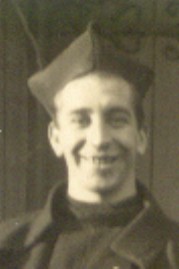
OBITUARY NOTICE OF FATHER MARTIN C.P. Fr. Martin of Our Lady of Sorrows passed peacefully to God in the early hours of January 11th, 1966. Mercifully he was spared what would normally have been a long, mentally deranging and excruciatingly painful illness. After a severe attack of influenza in November he did not recover as expected, and suspicions arose that he was seriously ill. The local doctor diagnosed tumour of the brain and exploratory examinations in Hexham hospital confirmed the diagnosis. An operation in Newcastle Infirmary proved that Fr. Martin’s case was desperate and that he only had a short time to live. He lingered for about three weeks, – peaceful, his cheerful self to the end, and perfectly resigned. When the brethren called to see him, his face lit up and usually, though his reflexes were very slow, he managed to concentrate for a few minutes and answer questions. When the Last Sacraments were administered, he did his best to reply to the prayers and kissed the crucifix with great devotion. Fr. Martin (Joseph Dougherty) was born in Belfast on May 27th. 1901. He was professed on Sept. 21st, 1919 at the Graan, Enniskillen, and completed his studies at Mount Argus and Sutton, where he was ordained on Sept. 18th. 1926. After his ordination he pursued a post-graduate course at the Angelicum University, Rome, where he obtained his Doctorate in Philosophy with distinction. After his return to the province, he taught philosophy to several classes of students. He was superior at Avenue Hoche, Paris from 1956 – 1962, and Rector at Sutton from 1962 – 1965. The Province owes him a great debt of gratitude for many reasons. Although he was a physically strong, athletic, adventurous and virile man, Fr. Martin remained at heart a child. Perhaps that is the truest short summary of his personality. He retained the child’s zest for life and the child’s curiosity about every form of life. Though he was not demonstratively affectionate, the children at Sutton loved him. They understood him; he understood them. He was a mate, a kindred spirit. Similarly the voluntary workers on the retreat house at Minsteracres love him. In fact, after his death, we were surprised to find how completely he had won their esteem and affection in such a comparatively short time. They vied with one another for the privilege of carrying his remains to his grave. Probably none of them had ever suspected that Fr. Martin was an intellectual, such was his simplicity and complete unself-consciousness. During the exploratory examination in Hexham hospital, the doctors were intrigued and, despite its tragic implications, amused by one of his replies. “Of course, Father”, one of them asked, “you know why you are in here?”. “O yes, there are three reasons, – social, political and economic. The economic reason is subdivided into ……” That was the first clue they had got that they were dealing with an intellectual. And so it always was. He was never pretentious, and it was only when a serious discussion started that the acuteness of his well-stored mind became evident. Fr. Martin was a man of many interests, and his versatility was perhaps his weakness. He had always many irons in the fire. He was the stuff that explorers are made of. Although he had considerable ability for abstract thought and retained his interest in Philosophy to the end, he was, by nature, a man of action, an instinctive mechanic and handy-man. His cell was invariably well-stocked with gadgets and tools, as well as with simple books of devotion such as the ordinary pious faithful use. His versatility and varied interests, – C.Y.M.S., study-circles, concerts etc. – prevented him from bringing any of his talents to full fruition. As a lector of philosophy, he was successful, though not, perhaps, to the extent that one had hoped. His enthusiasms and sudden insights sometimes ranged too far afield for any but his brightest students. However, he taught them to think and they loved him for his gentle charity, as did everybody else. He was never known to speak an unkind word. He frowned on any attempt to introduce uncharitable criticism into a conversation. He was charity itself to the sick and the downhearted, and always without fuss or effusiveness. In 1935 he translated and published “The Passion for the People”, an excellent little book of short, devotional meditations. His missionary activity was somewhat curtailed by his commitments at home, but wherever he went, whether for missions or retreats he did honour to the Congregation and made a host of friends and admirers. As superior at Paris he made many improvements to the property and re-animated the social and religious life of the Anglo-Irish-American community. At Sutton he was responsible for many improvements and extensions to the school buildings, and for the striking, long-desired new approach to the Church and Monastery. It was providential that he should have been superior at Sutton at the time of the beatification of Blessed Dominic. He supervised the exhumation of Blessed Dominic’s remains, the designing and construction of the artistic side-chapel and altar of the Beato, the satisfying celebrations of the great event, the organization of the Roman pilgrimage, and last but not by any means least, he scraped together the money to pay for it all. He drove himself mercilessly to the point of exhaustion and it was largely due to his self-sacrifice, administrative ability and untiring energy that everything went off so successfully. His drive and efficiency took a load of responsibility off the shoulders of the Provincial Curia. At heart a child, Fr. Martin never showed his years and remained vigorous and youthfully agile almost to the end. As charity covers a multitude of sins, and as Fr. Martin had little to cover, we may feel sure that he received a big welcome from his Divine Master, Whom he had served with such simplicity and devotion. May he rest in peace. Bernard C.P., Rector. Fr. Martin Dougherty, C.P. At the Passionist Monastery, Minsteracres, Consett, Co. Durham, the death took place on January 11th, of Rev. Fr. Martin Dougherty, C.P., a member of St. Joseph’s Province. A native of Belfast, the late Fr. Martin was born on May 27th, 1901 and was ordained at St. Anne’s Retreat, Sutton, Lancs., on September 18th, 1926. After ordination Fr. Martin pursued a post-graduate course at the Angelicum University, Rome where he obtained his Doctorate in Philosophy. For many years afterwards he was engaged in teaching. Later he was Superior of St. Joseph’s, Avenue Hoche, Paris, and Rector of St. Anne’s Retreat, Sutton, Lancs., where he did much to promote devotion to Blessed Dominic Barberi, C.P. (The Cross, Vol. LVI, 1965-66; p. 247)