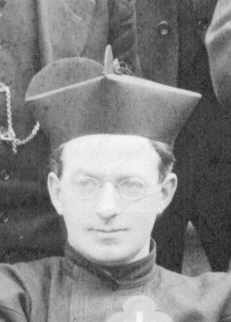
FATHER HERMAN (WILLIS), C.P. It is a characteristic of death that it can invest what was formerly merely familiar, or even seemingly common-place, with a lasting, personalised association with one who is mourned. A child’s toy may become a treasured keepsake; and a day which dawns as an uneventful date on the calendar may close as one which will henceforth be a cherished anniversary. It was thus on the evening of 30th January, 1956. The tones of the Angelus bell, ringing out from the tower of Mount Argus, were but the daily reminder of Mary’s undying message :. “Behold the handmaid of the Lord.” But for a great Passionist, slowly slipping into the gentle sleep of peacefully approaching death, those tones, one felt, were fittingly final, that message was beautifully personal. A Mother was coming to her son who had loved her devotedly and had served her well. And then, just as calmly and as gradually as the last echo of the Angelus died on the evening air, the life of a well-loved priest ebbed away. Fr. Herman was dead. It was the close of fifty-two years of Passionist life, the end of forty-five years of priestly endeavour. George Willis, as he was known in the world, was born in Armagh in 1886, and made his religious profession as a Passionist at St. Saviour’s Retreat, Broadway, Worcs. on the feast of the Presentation of Our Lady, 1904. He was raised to the priesthood in Dublin on 23rd September, 1911 by Archbishop Walsh. His first priestly assignment was as Professor at St. Ann’s Retreat, Sutton, Lancs. Then, in 1914, he was appointed Director and Professor of the Passionist Juniorate, which was then located at Sandymount, Dublin. It was an ideal appointment for one who was a classical scholar of such outstanding merit, who was possessed of such skill in fashioning and winning the heart of youth. From 1917 till 1919 he was Superior of the Juniorate, and when the postulants were transferred to Belfast, Fr. Herman accompanied them to Holy Cross, Ardoyne, In 1920 he began a six years’ sojourn in St. Ann’s, Sutton, serving first as Vicar, then as Rector. His last two years in England (1926-1928)were spent in Herne Bay, Kent. In 1928 he was recalled to the newly-formed Province of St. Patrick, and from that until his death he was a member of the community of St. Paul’s Retreat, Mount Argus, Dublin. No mere recitation of facts could convey an adequate appreciation of the sterling, talented, lovable qualities of Fr. Herman. As a preacher of missions and retreats he was known throughout Ireland and Great Britain. In that great work he was a staunch advocate of simplicity of style, but he could, when occasion demanded, show forth a masterly command of language and expression, a devastating logic and a burning eloquence. And everywhere he was revered as a gentle, patient, helpful confessor. Ever young at heart, he was beloved of every Passionist over whose formative years he so kindly and understandingly watched. . Many priests, as they offer the Holy Sacrifice for the repose of his soul, will remember gratefully that the first, strange, shy days of the life of an aspirant to the Passionist priesthood were made immeasurably easier, immensely happier because of the great, fatherly heart of Fr. Herman. Passionist life is poorer for his passing. His keen eye could ever see the homely humour of life, and his ready tongue could graphically portray it. With a twinkle in his eye, and a characteristic twist of his girdle, he had a racy anecdote for every occasion. But never by word or insinuation would he offend against charity. He was too big a man to be petty, too generous a man to be mean – with either God or men. And so we salute his memory as that of one beloved of all, and, we pray, rewarded by God. May he rest in peace. (The Cross, Vol. XLVI, 1955-56; p.296.) JXP OBITUARY NOTICE FATHER HERMAN OF OUR LADY OF GOOD COUNSEL Died January 30, 1956 At 6 o’clock on the evening of Monday, January 30, 1955, just as the Angelus was ringing, death claimed the soul of one of our best-known and most-beloved “brethren, Fr. Herman of Our Lady of Good Counsel. The news of his death came unexpectedly after an illness of only two weeks duration, during which he had first shown prospects of making a good recovery. Born in Ireland’s primatial city of Armagh on October 9th, 1886, George Willis was educated by the Vincentian Fathers at .Patrick’ s Diocesan College. Here he had a brilliant scholastic course, securing first-class Honours with distinction in Latin and Greek in the Senior Grade examination of the old Intermediate Board. In 1903 he entered the Passionist Novitiate at St. Saviour’s Retreat, Broadway, Worcs. where he made his religious profession on November 21st, 1904. Having completed his ecclesiastical studies at St. Paul’s Retreat, Mount Argus, Dublin, he was ordained by Most Rev. Dr. Walsh on September 23rd, 1911. In view of his outstanding ability he was appointed Lector, first at Sutton, later at the Alumniate, then established at Sandymount, Dublin. It was here in I916 that he first became acquainted with Mr Eamon de Valera, then an obscure professor of mathematics, later a noted Irish national leader and a figure of international renown. Fr. Herman became superior of the Alumniate in 1917, and here he first welcomed to the Passionist Congregation many a raw young postulant who later became a priest of distinction. In later years he often humourously recalled many a comical incident connected with their first faltering footsteps in the religious life. In 1920 Pr. Herman was appointed Vicar of St. Anne’s Retreat, Sutton, Lancs., and on the death of the Rector, Fr. Isidore Whelehan, in February, 1923, he was elected Rector, to which office he was re-elected at the Provincial Chapter of 1923. In 1926, he was transferred to Herne Bay, and on the division of the former Anglo-Hibernian Province, having chosen to come to St. Patrick’s Province, he was transferred to St. Paul’s Retreat, Mount Argus, Dublin, where he remained until his death almost thirty years later. He was such a familiar figure in our midst for so many years that it is hard to realise he is gone from us. His genial smile, his cheerful conversation, his general air of optimism were characteristic, and endeared him, not only to his brethren but to all who know him. On Tuesday, which was his regular day for duty, he was ever ready to !listen to and to console those who came to the monastery with heavy hearts. They went away happy in the thought that they had found an understanding and sympathetic friend, a priest of rare quality whose kindly ministrations had eased their burden and brought healing to their souls. As a missionary preacher Fr. Herman had preached both in England and in Ireland, the majority of his missions being in three Dioceses of Armagh, Down and Conor, and Dublin. His sermons were eloquent and well-prepared, and he possessed the facility of appealing both to mind and heart. In later years, as Professor of Sacred Eloquence, he passed on to many of our young missionaries the fruit of his experience. Assiduous in his attention to the sick, Fr. Herman spent many an hour by the bedside of those who were suffering and in pain. Never did he spare himself in this work of charity, nor did he ever complain of the labour and the hardship which it sometimes involved. As a confessor and spiritual guide he was much sought by convents. At the time of his death he was confessor to the Carmelite Nuns, Hampton, Drumcondra, Dublin., where he was always most regular in attendance each week. When they heard of his fatal illness, their prayers and sorrow were tokens of the loss they had sustained. Fr. Herman was a man of deep culture, well read in literature and particularly appreciative of the. arts. He had a wide knowledge of painting, particularly of the Italian schools, his favourite artists being Carravagio, Titian, Fra Angelico, Botticelli and Leonardo da Vinci. When the opportunity occurred he seldom failed to visit an Art Gallery to view the works of the great Masters. When in Rome for the Holy Year of 1950 he rejoiced at the opportunity of seeing those great masterpieces whose reproductions were familiar to him. For music, too, he had a keen appreciation and a comprehensive knowledge. But he was by nature of retiring disposition, and he never made a parade of his knowledge nor of his opinions. More than this, Fr. Herman had the rare gift not only of making friends but of retaining their friendship over the years. Some time after his departure from Sutton, every child in the school wrote a personal letter to him, each one saying how much they had missed him. That is no small testimony of friendship, and it is only one incident of many. Reticent about his spiritual life, Fr. Herman was a priest of deep and simple piety. His devotion to the Holy Mass, to the Blessed Sacrament and to the Sacred Passion were evident in his personal life as well as in his sermons and discourses; whilst his well-worn beads eloquently attested to his unfailing recourse to the Mother of God. He had given himself unreservedly t o God’s service, and when that service required – as it often did – sacrifice on his part, he did not complain. Amongst the papers and manuscripts found in his cell after death, this little verse seems singularly appropriate; “Whcn I am dying, how glad I shall be That the lamp of my life has burned out for Thee That anguish of spirit full often was mine Since anguish of spirit so often was Thine My cherished Rabboni how glad I shall be To die with the hope of a welcome from Thee.” That hope was surely fulfilled in his passing. He was working about His Master’s business until the day when stricken down by fatal illness. A cerebral thrombosis brought about an unexpected collapse in the midst of his duties. He was brought to his cell where he was anointed, but after some days he seemed to recover and hopes were entertained that he would be spared. Alas, those hopes were in vain. On the Thursday before his death, he gradually sank into a coma, and later lost consciousness. The prayers for the dying were recited by the community on Saturday night, and for the next few days, members of the commmnity in turn watched by his bedside with assiduous charity.. Assisted by continuous prayer, his soul took to flight on January 30th and he peacefully slept in the Lord. The obsequies took place on Thursday, February 2nd, Feast of the Purification of Our Blessed Lady. Solemn Requiem Mass was celebrated by Very Rev. Father Fergus, C,P , Provincial, assisted by Rev. Fr. Michael, C.P,, as deacon, and by Rev, Fr. Germain, C,P., a class-mate of the deceased, as subdeacon. The funeral was attended by a large gathering of the brethren of both Provinces, and by a representative body of the secular and regular clergy. May his good soul enjoy eternal rest.’ May he rest in peace. Edmund of the Blessed Virgin, Rector,