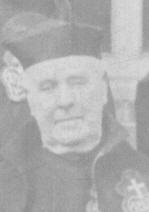
Rev. Fr. Anthony (Dogherty), C.P. We regret to chronicle the death of Father Anthony of the Seven Dolours, which occurred at St. Paul’s Retreat, Mount Argus, Dublin, on June 28th, 1949. Born at Rasharkin, Co. Antrim, on January 7th, 1877, Daniel Dogherty at first adopted teaching as his chosen career. He was trained at St. Patrick’s Training College, Drumcondra, Dublin, and taught for some years at Rock and Hannahstown, Co. Antrim. At the age of thirty, however, he received his vocation to the priesthood and was professed as a Passionist on September 4th, 1907. He was ordained in Dublin on December 21st, 1913, and during his active life, was attached to various Passionist Retreats in England and Ireland, including Highgate, London; Sutton, Lancs.; The Graan, Enniskillen; Ardoyne, Belfast. Fr. Anthony had a commanding presence and a vigorous personality. As a missioner, he was deservedly popular, for his sermons were characterised by a lively wit and a spirituality. that was both deep and practical. The last years of his life, which were rendered inactive by a disability, resulting from an accident, were spent at St. Paul’s Retreat, Mount Argus. He bore his increasing infirmity with undiminished patience, and accepted death, as he had faced life, with a brave heart and complete conformity to God’s inscrutable Will. May he rest in peace. (The Cross, Vol. XL, 1949-50; p.107) OBITUARY FATHER ANTHONY OF THE SEVEN DOLOURS. Death was merciful when it came to take Father Anthony of the Seven Dolours, a member of St. Patrick’s Province. For some months Father Anthony .had been suffering intense and constant pain from an ailment which was not subject to surgical treatment and for which the best medical care could provide little relief. A few days before his death, he remarked to a religious who visited his cell, “I did not think that it was possible to suffer such pain and still survive”.. This observation was the more remarkable coming as it did from one who had had so much experience of suffering, though he bore the excruciating pain with truly Christian fortitude, it was the prayer of all who saw him suffer that God would mercifully intervene to release him from his suffering; and that prayer was heard. During the last few days of his life, the poor sufferer enjoyed comparative ease and his death in the early morning of June 28th., 1949, was without distress. Born in the village of Rasharkin, Co. Antrim, on January 9th. 1377, Daniel Dogherty at first adopted teaching as his chosen career. He became a student of St, Patrick’s Training College, Drumcondra, Dublin, from which, in due course, he graduated with distinction. He taught successfully for some years at Primary Schools at Rock and Hannastown, Belfast, and it was at this time that he first became acquainted with the Passionist Congregation. At the age of thirty, forsaking the career that had opened so promisingly, he decided that his true vocation was to the priesthood. Although well passed the usual age for postulants, he displayed unusual humility in entering the Passionist Novitiate at St. Saviour’s Retreat, Broadway, Worcs., where he made his religious profession on September 4th., 1907, taking the name of Anthony of the Seven Dolours. His studies for the priesthood were made at St. Paul’s Retreat, Mount Argus, and he was ordained in Dublin on December 2Jst,, I9J3. Father Anthony became a member of the missionary staff and was a member of the communities at St. Joseph’s Retreat, Highgate, London, and St. Anne’s Retreat, Sutton, St. Helen’s, Lanes. Gifted with a commanding presence and a vigorous personality, father Anthony was deservedly popular on the missions. His sermons were characterised by a lively wit, and a spirituality that was both deep and practical. He specialised in a homely, forceful style of preaching, and frequently enlivened his theme by simple anecdotes and appropriate examples. His tall, well-built figure was seen to advantage on the mission platform, whilst his abounding energy and strong physique well fitted him to cope with the arduous labour of continued missionary work. When the Alumniate for the former Anglo-Hibernian Province was established temporarily at Sandymount, Dublin, Father Anthony was appointed to the professorial staff. The work of teaching, for which he had been intensively trained, was congenial to him, and he proved unusually successful in this important task. Many of the young men who studied under his direction afterwards attained positions of distinction in the Province. In after years, his colleagues invariably spoke with the utmost affection of Father Anthony, and told many a tale concerning his diligence with his pupils. For a period also, Father Anthony was Editor of THE CROSS which at that time, was experiencing technical difficulties. His cultured mind soon impressed itself upon our periodical, and the difficulties were successfully surmounted. Father Anthony was a really well-read man, intimately acquainted with the classics, and with a good knowledge of the best authors in modern literature. He held some opinions, which he could express in pungent phrases, well-salted with homely humour. Throughout his whole life he retained, and was proud of, the pronounced northern accent, characteristic of his birthplace, and he had little patience with those who would have preferred anything else. He was very good-humoured, and was the life and soul of the community recreation. His deep hearty laugh was a tonic for the depressed, and his unaffected good spirits made him an ever-welcome companion. On the division of the old Anglo-Hibernian Province, Father Anthony was appointed to the Province of St. Patrick, and was transferred to St. Gabriel’s Retreat, the Graan, Enniskillen. It was about this time that he sustained an accidental fall, as a result of which he became permanently incapacitated. He was able to make his way around the monastery, with the aid of a stick, although such a slow method of progress often caused him great pain. Despite this ailment, however, he continued to bear his share of the” community work, as far as it was possible for him to do so. On his transfer to St. Paul’s Retreat, Mount Argus, he was appointed one of the spiritual fathers of the community, and discharged this office with devoted assiduity. His wise counsel and his long experience were ever at the disposal of those who sought his advice and direction. For quite a while before his death he was confined to his room, and for some months he was confined to bed. This enforced inactivity aggravated the old injury to his leg, and a very painful ailment of the foot supervened. When the news was conveyed to him that his condition was incurable, and indeed fatal, he bore his steadily-increasing pains with undiminished patience, and accepted death, as he had faced life, with a brave heart and with complete conformity to God’s inscrutable Will. Eternal rest give unto him, 0 Lord, and may perpetual light shine upon him..