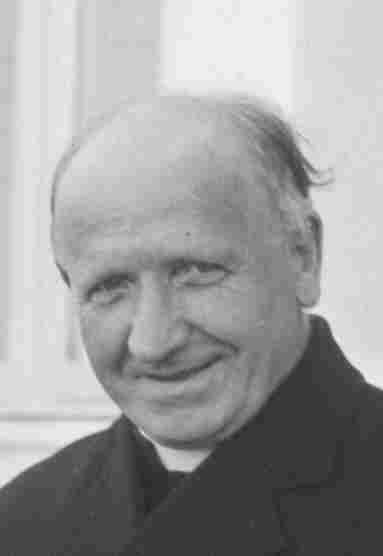
Obituary Notice of FATHER GERALD O’BOYLE C.P. When the community of St. Paul’s Retreat assembled in choir on the morning of Friday, March 29th.1968, they were shocked and grieved to learn that Fr. Gerald had died during the night. He had been missing from his place in the choir and the refectory for a few days, but it had been generally understood that the indisposition which confined him to his room was nothing more than a passing ailment. He himself would seem to have had a presentiment of his approaching end, and the doctor was concerned about his heart condition., but there was no indication that death would come so soon and so suddenly. However, when it did come, it found him fully conscious and prepared. He died sitting on the side of his bed, with his crucifix in his hand. Fr. Gerald was in his eighty-fifth year when God called him, having spent sixty-five of these years as a Passionist, and sixty-two of them as a priest. Born at Randalstown, Co. Antrim on July 24th.1883, he was the youngest of a family of twenty-one. Early in life, his thoughts turned towards the priesthood; and when he had finished his primary education at the local National School, Francis O’Boyle – as he was then known – entered the Diocesan Seminary, St. Malachy’s College, Belfast, with the intention of following the example of an older brother who had become a priest of his native diocese, Down and Connor. However by the time he completed his Philosophy Course at St. Malachy’s he had second thoughts about his vocation, and following the advice of his spiritual director decided to apply for admission to the Passionist Congregation. His application was accepted, and after the usual year’s novitiate, he made his Religious Profession at St. Saviour’s Retreat, Broadway, on April 14th.1904; after which he was transferred to St. Paul’s Retreat, Mount Argus, where he completed his studies for the priesthood and was ordained on September 22nd.1906. As a student, his considerable intellectual ability and sound scholarship had come to the notice of his superiors, and almost immediately after ordination, he was appointed Lector of Theology at Mount Argus which was then the theologate of the Anglo-Hibernian Province; and during fourteen years he held this office, he proved himself a competent and painstaking teacher who could not only impart knowledge but also inspire his students with his own priestly zeal and dedication to the Passionist apostolate. Many years later, on the occasion of his Silver Jubilee (1931), his former students would avail of the opportunity to present him with a chalice as a token of their gratitude for the help and inspiration he had given them. During these years at Mount Argus, he also managed to combine a considerable amount of apostolic activity with his work as Lector. Besides taking his share of the ordinary church duties, and giving an occasional Mission or Retreat, he was for many years Director of the Men’s Branch of the Confraternity and of the local Pioneer Council. These activities, together with his part in organising the Ovada Bazaar, brought him into contact with a large circle of people from all walks of life, and did much to shape the pattern of his priestly ministry and gave direction to his apostolic zeal. For a man who was naturally shy and of a retiring disposition, he had an unusual gift for winning the affection and esteem of those who came to know him; and many who made his acquaintance during these years were to remain lifelong friends. Not a few of those he had received into the Confraternity as young men would stand at his graveside with tears in their eyes. It was also during this period that he first became known as a particularly sympathetic and painstaking confessor and spiritual director. He was especially popular with the young men in the district, many of whom were then active in promoting the militant national movement which would culminate in the Uprising of 1916 and the subsequent war of Independence. A staunch nationalist himself, he was in sympathy with the aspirations of the movement, and became the personal friend of some of its leaders, but he avoided becoming implicated in its activities. This policy of non-involvement was to remain a guiding principle throughout his life. Although he took a keen interest in politics and public affairs generally, he always stopped short of partisanship. First and above all, he was always a dedicated priest whose attitude towards people and affairs was determined by his priestly concern for the spiritual welfare of those who entrusted themselves to his direction, and they, on their part, understood his attitude and respected him for it. As a consequence, during the Civil War and its aftermath of bitterness, he was able to retain the trust and friendship of men of both sides, and afterwards could use his influence to bring many of them together again when the bitterness had time to abate. While still a Lector, he was transferred to St . Anne’s Retreat, Sutton in 1919, along with the class of students he was then preparing for ordination. This was to be his last teaching assignment. At the Provincial Chapter, which took place the following year, he was elected to the Rectorship of St. Gabriel’s Retreat, Enniskillen, – an appointment which presented a formidable challenge to a comparatively young and inexperienced superior. St. Gabriel’s then was a relatively recent foundation in the process of finding its feet after the storm of opposition which had threatened its beginnings. However, the Chapter’s confidence in Fr. Gerald’s ability to meet this Challenge was amply justified. During the six years of his Rectorship, the affairs of the Retreat prospered, the present church was built, and relations with the diocesan authorities and clergy improved to such an extent that, when the new church was completed, the Bishop of the diocese accepted an invitation to preside at its solemn dedication. His two terms as Rector having expired, Fr. Gerald remained at St. Gabriel’s for the next six years, the last three of them as Master of Novices, to which office he was elected by the first Chapter of the newly constituted Province of St. Patrick (1929). During his term as Novice-Master, his health began to give him cause for anxiety; and at the Provincial Chapter in 1932 , he asked the Capitulars not to consider him for office. After the Chapter, however, he was appointed Vice-Postulator of the Cause of Father Charles, with Mount Argus as his residence and base of operations. This was an assignment which was very much to his liking and for which he was particularly well fitted. While he was a student and young priest in Mount Argus, memories of Father Charles were still fresh. He was still talked about in the community by those who had lived with him, and also by the people of the neighbourhood who had wonderful stories to tell of his remarkable holiness, his extraordinary gifts, and the scenes of popular devotion which preceded and accompanied his funeral. From their accounts of him, Fr. Gerald became a convinced believer in the heroic sanctity of Father Charles and an ardent promoter of his Cause for Beatification. On his appointment as Vice-Postulator, he lost no time in searching out and interviewing any who could give reliable first-hand evidence of the holiness and extraordinary gifts of the Servant of God; and it was due in no small measure, to the zeal and care which he put into this investigation that the Cause was formally introduced and the Preliminary Processes brought to a successful conclusion. To the end of his life Fr. Gerald persevered in his efforts to promote the Cause; and in spite of the inevitable but exasperating delays in its progress, he never faltered in his conviction that Father Charles would eventually be recognised by the Church as a Saint. At the fourth Provincial Chapter (1938), he was again called upon to shoulder the burdens of office, this time as Rector of Mount Argus; and in the three years he was to hold this office, he again proved himself to be blessed to an unusual degree with those gifts of grace and nature which combine to make a successful superior. He had no head for the practical details of day-to-day administration; but he was fully aware of his limitations in this respect, and had the good sense to leave those to others, and to give his attention to the other and more important duties of his office. His outstanding quality, as a superior, was his kindness and his real concern for the wellbeing and happiness of the religious. Generous almost to a fault, he liked to anticipate their needs, gave them every help and encouragement in their work and apostolic activities, and spared no efforts to foster among them a happy family spirit. Superiorship, however, has a way of discovering and high-lighting a man’s weaknesses and inadequacies; and Fr. Gerald had his share of these. He had an excitable temperament which was usually well controlled, but could on occasion explode in a hectic display of impatience. Again – and perhaps because of his temperament – he found it practically impossible to introduce any semblance of method into the organisation of his work and affairs. These two shortcomings could sometimes combine to create situations of farcical confusion. Many will remember the chaotic scenes which sometimes took place during the closing ceremonies of his Visitations, when the notes for his final address and admonitions became hopelessly disorganised, and books and papers were thrown round in an abandon of exasperation. He was particularly liable to excitement on occasions of importance when his anxiety that everything should go smoothly set him on edge. Any hitch in the arrangements could spark off an outburst, in which he was likely to vent his impatience on those nearest to hand, regardless of their responsibility for what had happened. But these outbursts passed quickly, and those who had borne the brunt of them would usually find themselves the recipients of some little gift or favour which he intended to be accepted as an informal apology. These shortcomings, however, were more than offset by the many good qualities for which his community esteemed him; and it was with mixed feelings they heard the announcement at the next Chapter (1941) that their Rector had been taken from them to be elected the Major Superior of the Province. It was perhaps unfortunate for the Province that the six years he was to hold this office happened to coincide more or less with the difficult and anxious period of World War II and its immediate aftermath, when prevailing conditions excluded the possibility of any development or new apostolic enterprise. What he might have achieved in more favourable circumstances must remain a matter of surmise; but the enthusiasm with which he welcomed the developments of later years gives reason to suppose that, if the opportunity had been available, he would have left the Province some fitting memorial to his apostolic zeal. He was already in his middle sixties, when the seventh Provincial Chapter (1947), at his own request, relieved him of the responsibilities of office. The remaining twenty years of his life he was to spend as a valuable and respected member of the Mount Argus community, following the regular observance and taking his full share of the community’s apostolate, for as long as his strength permitted . These were for him the most satisfying years of his life, and perhaps – if all could be told – the most profitable. It was the appeal of the Passionist apostolate which had first turned his thoughts towards the Congregation, but as Providence would have it, he was to spend the greater part of his active life in offices and occupations which would give him little opportunity to undertake the preaching of Missions and Retreats. In any event, while there can be no question about his apostolic zeal, he would not seem to have had the gifts or temperament to make a successful missioner. He did give a number of Missions, but he had greater success as a conductor of Retreats for Religious, of which he gave a considerable number throughout his life. In many Religious Communities throughout Ireland, his Retreats are still remembered, not so much because of his lectures as for his patience and practical wisdom as a confessor and spiritual director. In the designs of God it was as counsellor and confessor that he was to find an outlet for his apostolic zeal and the fulfilment of his Passionist vocation. As a young priest, he had already earned for himself a widespread reputation as a confessor. Many of those who profited from his direction then were to remain life-long penitents of his; and in the course of the years, they were joined by many others who came to regard him as their ‘Anam Cara’, – their soul-friend. These included people from all walks of life, priests and religious, professional men and politicians, working men and housewives, some of them coming long distances to take their turn outside his confessional. While still a comparatively young priest, he gave a Retreat to a Community of Sisters in a town on the western sea-board. Over forty years later, the Superioress of the same convent told another Passionist that, when any of the older Sisters had occasion to go to Dublin for a few days, they always tried to arrange that their visit would include a Wednesday, when they would be sure of finding Fr. Gerald in his confessional. This is but one of the many examples which could be quoted to illustrate the extraordinary influence which he exercised over his penitents. It is not easy to analyse this influence or to identify the qualities which made it so unusual. To a certain extent, it can be attributed to his kindness and the deep understanding of human nature which he had acquired from long experience in directing souls; but there was something more, – something which his penitents regarded as special. It may have been some gift of grace which enabled him to impart to others that peace of soul which comes from a deep faith in God’s mercy and love. In his later years, when the other duties of the priestly ministry were beyond him, he devoted himself almost entirely to the apostolate of the confessional. Indeed, it can be said that his confessional was the centre round which his life revolved. His daily and weekly routine followed a regular pattern, designed to suit the convenience of his regular penitents, as well as the occasional callers who came to him for spiritual direction and consolation. The very last week of his life may be taken as typical. For an hour or so each morning, during the early Masses, he knelt near his confessional, ready to attend to any who needed his services; and for the rest of the day, made himself available to callers in the parlours. He took his regular day on duty on the Wednesday, attended his confessional on the Saturday afternoon, and spent the Sunday visiting penitents and friends who happened to be in hospital or confined to their homes by sickness or old age. Because of its nature, the fruits of such an apostolate cannot be estimated; but the hundreds who mourned his death, many of them with tears, was a tribute which any priest might envy, and – to borrow the words of Fr. Leo Trese – ‘an earnest, to a just Judge, of a mercy deserved of mercy given.’ The most remarkable feature of Fr. Gerald’s declining years was, perhaps, his refusal to withdraw into himself and let life pass him by. Even when he had celebrated the Diamond Jubilee of his ordination, and must have recognised that his remaining days were few and uncertain, he did not allow the prospect of his approaching end to dampen his zest for living, or to diminish the keen interest and pleasure he had always found in the life that went on around him. Blessed with a strong physical constitution which had never been weakened by serious illness, he continued to enjoy remarkable good health, and was spared many of the disabilities which often accompany old age. To the end, his senses and mental faculties remained unimpaired to any noticeable degree; and at heart he remained as young as ever, interested in everything that was happening in the community and in the Province, and always ready to enjoy any fun that was going. To those who were privileged to live with him in his last years, his quiet cheerfulness and contentment provided a fine example of a priest and religious growing old gracefully and peacefully, treasuring the gift of life and using it to the full in the service of souls, yet always ready to accept death, whenever it came, with complete trust in God’s loving mercy. That trust was not to be in vain. God gave him the kind of death he must have desired and prayed for. He died with his eyes and thoughts fixed upon the crucifix. The news of Fr. Gerald’s death was received with sorrow and a feeling of loss by all who knew him, particularly by those who had come to regard him as their spiritual father. Many of then came to pay their last respects, when his remains were laid out in the monastery; and not a few of them, men and women, wept while praying by the side of his coffin. Others, who could not come, sent messages mourning their loss, amongst them Senator Margaret Pearse who wrote: ‘Deeply grieved at the loss of a life-long friend and my confessor for fifty-four years’. The funeral ceremonies, attended by His Excellency Eamon De Valera, President of Ireland, took place on Monday, April lst, Most Rev. Dr. Dunne, Bishop of Nara, presiding in the sanctuary. Both Mr. De Valera and Dr. Dunne were for many years close friends of Fr. Gerald’s, as were most of the large congregation who assisted at the Concelebrated Requiem Mass for the repose of his soul. Pie Jesu Domino, dona ei requiem. Sylvius McGaughey, C.P. Rector. REV. FATHER GERALD, C.P. ON September 22nd, Rev. Father Gerald (O’Boyle), C.P., St. Paul’s Retreat, Mount Argus, celebrated the Golden Jubilee of his priestly Ordination. On that joyous occasion, he received the sincere prayerful wishes of his brethren in religion and of his many friends who, through the years, have come to appreciate his kindliness and sterling worth. In these countries, during the past century, only six other Passionist Fathers have known the happiness of spending fifty years in the Sacred Priesthood. BORN near Randalstown, Co. Antrim, in 1883, Father Gerald was professed a Passionist at St. Saviour’s Retreat, Broadway, Worcs., and was ordained in 1906. For many years thereafter, he was Professor of Sacred Theology at Mount Argus. Other offices held by the Jubilarian included Director of Students, Master of Novices and Provincial Consultor. From 1920 till 1926, he was Rector of The Graan, Enniskillen, during which time he built the lovely Renaissance Church dedicated to St. Gabriel. Having completed his term as Rector of Mount Argus in 1941, Father Gerald became Provincial of St. Patrick’s Province, which office he held until 1947. As missioner and retreat-master, but particularly as spiritual director and confessor, he has won the affectionate regard of countless souls. It is our fervent wish and prayer that the joy of his Jubilee Day may long endure to illumine the years to come. (The Cross, Vol. XLVII, 1956-57; p. 203.) Diamond Jubilee of Ordination A DIAMOND JUBILEE of ordination is a very rare event. To have spent sixty years in the priesthood is indeed an occasion for rejoicing and for congratulation. On Thursday, September 22nd, 1966, Rev. Father Gerald (O’Boyle) C.P., celebrated his sacerdotal Diamond Jilbilee. Born near Randalstown, Co. Antrim, in 1883, Father Gerald was the youngest of a very large family. He was professed a Passionist at St. Saviour’s Retreat, Broadway, Worcs., and was ordained in 1906. For many years after ordination he was Professor of Sacred Theology at Mount Argus. FROM 1920 until 1926 he was Rector of St. Gabriel’s Retreat, Enniskillen, during which time he built the beautiful Renaissance church dedicated to St. Gabriel. Having completed his term as Rector of Mount Argus in 1941, Father Gerald became Provincial of St. Patrick’s Province, which office he held until 1947. This period embraced the troubled years of World War II, and in 1946 Father Gerald attended the General Chapter in Rome, which helped to solve many post war problems. In recent years he has been Vice-Postulator of the Cause of the Servant of God, Fr. Charles. As missioner and retreat master, but more particularly as spiritual director and confessor, he has won the affectionate regard of countless souls. A HIGH MASS of thanksgiving was celebrated at Mount Argus to mark the occasion. During the Mass a telegram from Vatican City was read, conveying the Apostolic Blessing upon the jubilarian. Messages were also received from the President of Ireland and from the Superior-General of the Passionists, Most Rev. Fr. Theodore Foley, C.P. It is our fervent wish and prayer that the happiness of the Jubilee Day may long brighten the years that are yet to come. (The Cross, Vol. LVII, 1966-67; p. 187) Obituary A FAMILIAR AND well-loved figure was removed by the swift hand of death when Fr. Gerald O’Boyle, C.P., was found dead in his room at Mount Argus on Friday, March 29th. Father Gerald was in his eighty-fifth year and had been a priest for sixty-two years. Born near Randalstown, Co. Antrim, in 1883, the late Fr. Gerald was the youngest of a very large family. He made his Passionist profession in 1904 at St. Saviour’s Retreat, Broadway, Worcs., and was ordained in 1906. For many years after ordination he was Professor of Dogmatic Theology at Mount Argus, Dublin. At the Provincial Chapter of 1920 he was elected Rector of St. Gabriel’s Retreat, Enniskillen, an office which he held for six years. During this time he built the beautiful Renaissance church dedicated to St. Gabriel. At a later date he was elected Rector of Mount Argus, and on the completion of a three-year term he became Provincial of St. Patrick’s Province until 1947. This period included the troubled years of World War II, and in 1946 Fr. Gerald attended the General Chapter in Rome which helped to solve many post-war problems. For many years Fr. Gerald, as Vice-Postulator of the Cause of Fr. Charles, was untiring in his efforts to spread a knowledge of the Servant of God. He had much, to do with the successful completion of Diocesan Informative Processes during which many witnesses were examined. In September, 1966, Fr. Gerald had the happiness of celebrating the Diamond Jubilee of his ordination, a very rare, event among the Passionists. On this occasion he received numerous messages of congratulation, including one from his life-long friend, the President of Ireland. It is especially as a confessor and spiritual director that the name of Fr. Gerald will best be remembered. From all parts of the city countless numbers came to seek his advice and to find comfort in his words of consolation. Gentle and quiet in manner, he had the gift of being able to reassure the timid, to encourage the faint-hearted, to console those in sorrow. His Sundays were invariably spent in visiting the sick with a special care for those who were nearing the end. He was around and about as usual up to the day before he died. And his own death, as he would have wished it, was as quiet and calm and gentle as his life May he rest in peace (The Cross, Vol. 59; 1968-69; No. 1, page 26)