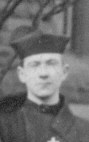
OBITUARY NOTICE OF FR. LEONARD, C.P. With the death on April 2nd, 1966 of Fr. Leonard Maccabe, the Province of St. Joseph lost one of its great missioners. Born at West Calder, Midlothian, August 29th, 1895, Fr. Leonard of the Sorrowful Virgin (Thomas Augustine Maccabe) saw early the life to which God was calling him and joined the Congregation when he was sixteen years of age. Having made his novitiate at St. Gabriel’s, Enniskillen, he was professed on July 24th, 1912. After the usual course of sacred studies, he was ordained by Archbishop Whiteside of Liverpool at St. Anne’s, Sutton, on February 28th, 1920. He then began a life of apostolic work that must be styled extraordinary in its activity and variety. Missions and retreats were his chief work, of course, and there can be few places in these countries in which he did not preach at one time or another. But he was to engage in other fields of the apostolate with the devotion he had shown and the success he had gained in the work of missions and retreats. When Dr. Herbert Vaughan, Superior of the Catholic Missionary Society, appealed to the religious orders for help, Fr. Leonard was an obvious choice for the Provincial to appoint to this work. For many years he laboured up and down the country with the “Motor-Mission” in the company of such distinguished figures as Dr. Downey (afterwards Archbishop of Liverpool), Canon Arendzen, Fr. Owen Dudley, Fr. Martin Dempsey and Fr. George Nicholson, C.SS.R. The newly-formed Catholic Evidence Guild also attracted him and for many years he spoke at the various outdoor platforms in England. He broke new ground in the apostolate. Missions to workers’ camps are a common feature of the apostolate today. They were not so in 1932 when Fr. Leonard preached a mission in a reservoir scheme workers’ camp on the Yorkshire moors – a mission described by a Catholic paper of the day as “unique in England”. Devotion to Our Lady was a marked note of his spiritual life and united to his apostolic zeal led him naturally to support the Legion of Mary that had begun in Dublin not long after Fr. Leonard had commenced his missionary labours. In friendly association with Frank Duff, its founder, he did much to introduce the Legion into England and his devoted work for it won him the honour of Laureate member. He was as active in the apostolate of the pen as he was in that of the spoken word and featured prominently in the religious journals of the twenties and thirties, writing interestingly on a variety of subjects. When war broke out in 1939 he became an Army Chaplain and served with the Eighth Army in its African and Italian campaigns. High courage and selfless devotion to his men won him a deserved reputation. When the war was over he took up once again the work of missions and retreats, a work that was to end only with his death. This period of his life included a term as Rector of St. Paul’s Retreat, Ilkley. The vigorous health he habitually enjoyed had indeed deteriorated to some degree in later years but there was no indication that death was near when he entered hospital in March for an operation for an obstinate internal inflammation. The operation was successful and he seemed to be making a good recovery but complications set in and he suddenly became dangerously ill. He met the crisis with the fortitude native to him, perfectly resigned to the will of God. He died peacefully in the evening of April 2nd. His funeral took place at St. Joseph’s, Highgate, on April 5th and was attended by a large number of his brethren from both Provinces in addition to a large congregation of parishioners, friends and relatives as well as many nuns. The Cardinal Archbishop of Westminster was represented by his Auxiliary and Vicar-General, Bishop Casey. Fr. Leonard now lies among his brethren in the mausoleum in the grounds of St. Joseph’s, Highgate. The memory of his inspiring life will long endure. He served the Congregation well over a long life. He was not indeed free from the faults that are a part of the human condition but it is no mere charitable tribute to say of him that he was a great Passionist. He had a great pride in the Congregation – its potential and its achievements. On missions and retreats he was tireless in the search for souls and distinguished for his good example and for his adherence to the hallowed customs of the Province. He was a missioner in the great tradition of the Congregation – zealous, talented, versatile. He preached an extraordinary number of missions. Precise figures are not available but after his death four hundred and thirty one sermon manuscripts were found in his room – sufficiently eloquent witness to the industry and apostolic zeal that were the pattern of his life. May he rest in peace. Hubert, C.P. Fr. Leonard MacCabe, We regret to chronicle the death of Rev. Father Leonard MacCabe, C.P., a well-known member of the Province of St. Joseph, which took place after a brief illness at Highgate, London on April 2nd, 1966. A native of West Calder, Fife, Scotland, where he was born on August 29th, 1895, the late Fr. Leonard was only sixteen years of age when he sought admission to the Passionist Congregation. Having completed his novitiate at St. Gabriel’s Retreat, The Graan, Enniskillen, he made his religious profession on July 24th, 1912. After the usual course of ecclesiastical studies, he was ordained at St. Anne’s Retreat, Sutton, St. Helen’s, by Most Rev. Dr. Whiteside, Archbishop of Liverpool on February 28th, 1920. An eloquent and forceful preacher, Fr. Leonard was soon in action as a missioner and retreat-giver in many parts of England. He was very interested in the apostolic work of the Catholic Evidence Guild and frequently spoke at open-air meetings in Hyde Park, London, and at the Bull Ring, Birmingham. He was also a keen promoter of the Legion of Mary. Despite the many demands on his time, he found opportunity to contribute articles to THE CROSS on a variety of topics. During World War II he served as an Army Chaplain and was attached to the Eighth Army with which he saw service in the North Africa and Italian campaigns. For a term he was Rector of St. Paul’s Retreat, Ilkley, Yorks., and for the past twelve years was actively engaged at St. Joseph’s Retreat, Highgate, London. (The Cross, Vol. LVII, 1966-67; p. 26)