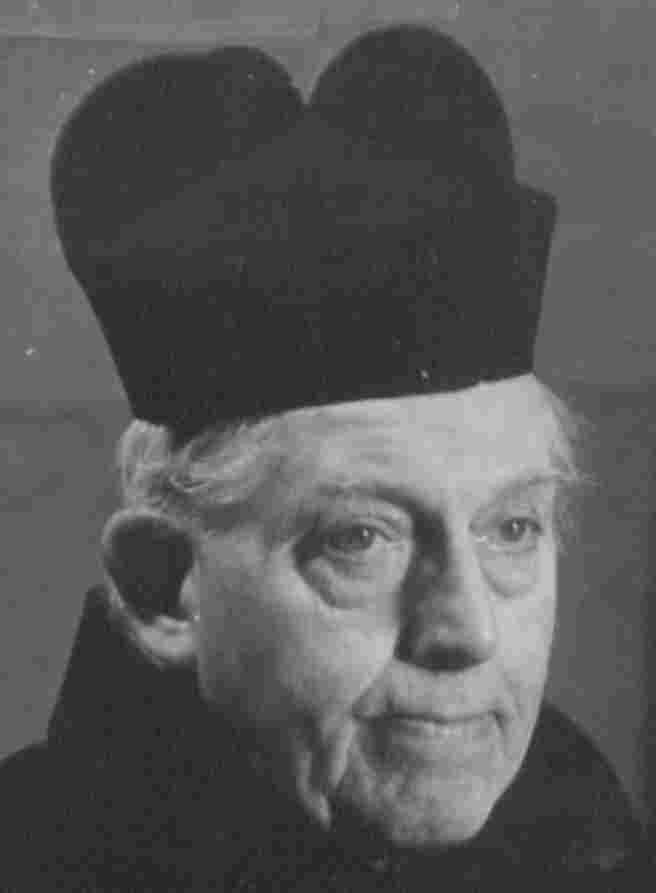
GOLDEN JUBILEE OF REV. FR. EUSTACE, C.P. THE Golden jubilee of a priest’s ordination is always an occasion for rejoicing and congratulations. The celebration of the Golden jubilee of Rev. Father Eustace, C.P., St. Gabriel’s Retreat, The Graan, Enniskillen, recalls the memories of his fifty years’ labours in God’s vineyard. Born at Garrison, Co. Fermanagh, on July 10th, 1863, Father Eustace is the last surviving member of his family. He can still recall boyhood memories of the stirring times of the Land League, and of the wholesale evictions in the Glenfarne district. In his late twenties, Fr. Eustace left his home to enter the Passionist Congregation. He made his novitiate at St. Saviour’s Retreat, Broadway, Worcs., and was ordained there on June 4th, 1898. A short time later he was appointed to the Passionist Church at Avenue Hoche, Paris to minister to the needs of English-speaking Catholics in the French capital. At the turn of the century the Mason-dominated Government of France commenced a persecution of religion, and decreed the expulsion of religious communities. Father Eustace personally witnessed the compulsory closing of several convents, and the clashes between the incensed people and the military who were sent to enforce the official decree. The Passionists shared the general fate and the community was expelled from Avenue Hoche. After some years at St. Joseph’s Retreat, Highgate, London, Fr. Eustace found a new field of labour at St. Louis, Missouri, where he spent nine years, 1905-1914. On the outbreak of war in 1914, he was recalled to England, where he acted as hospital chaplain at Herne Bay, Kent. Fr. Eustace recalls that on one occasion, a contingent of over one hundred men, who had recovered from their war wounds, were sent to France. Within 24 hours of their arrival, all but three had been killed. Father Eustace can still vividly remember the wonderful enthusiasm with which Irish-Americans received the news of John Redmond’s fight for Home Rule, and their keen disappointment when it failed to secure its object. In the early years of the Home Rule agitation, Irish-Americans intimated in their thousands their intention to invest their savings to promote the industrial and agricultural development of an independent Ireland. The Western Catholic, a paper edited by a Father Foley, had to treble its size just to carry lists of the names of sympathizers in the Middle West who, were willing to donate considerable sums to help to develop their native country under Home Rule. During the dreaded influenza outbreak of 1918-1919, Fr. Eustace was busily engaged in attending to the sick and the dying in London, Glasgow, Belfast, often being called upon to replace a priest who had succumbed to the fatal disease. In 1920, Fr. Eustace was recalled to The Graan where for some years he acted as Vicar. His keen interest in agriculture specially fitted him for the task, and under his wise and prudent direction, the most advanced and intensive methods of cultivation were actively pushed forward. Now that rheumatism confines him to his room, Fr. Eustace finds his main solace in reading. His mental alertness and delightful sense of humour remain unimpaired by advancing years. It has been one of his great pleasures to read the vast numbers of messages of congratulation that have come from friends far and near, who have joined with this grand old Passionist in celebrating his Golden Jubilee. On behalf of our readers, The Cross adds its word of joyful felicitation, with the prayer that God may bless and protect and add many more happy years to a life already fruitful in labours and blessings. (The Cross, Vol. XXXIX, 1948-49; p. 135) On February 13th, at St. Gabriel’s Retreat, The Graan, Enniskillen, Rev. Fr. Eustace C.P. passed to his eternal reward. Known in the world as Joseph M’Auley, Fr. Eustace was born at Garrison, Co. Fermanagh, on July 10th, 1863. In later life he could still recall boyhood memories of the stirring times of the Land League, and of the wholesale evictions in Glenfarne district. In his late twenties he left his home and entered the Passionist Novitiate at St. Saviour’s Retreat, Broadway, Worcs., where he was ordained on June 4th, 1898. Shortly after his ordination he was appointed to the Passionist Church at Avenue Hoche, Paris to minister to the needs of the English-speaking Catholics in the French capital. At the turn of the century the Mason-dominated Government of France commenced a persecution of religion and decreed the expulsion of religious communities. Fr. Eustace personally witnessed the compulsory closing of several convents, and the clashes between the incensed people and the military who were sent to enforce the official decree. The Passionists shared the general fate and the community was expelled from Avenue Hoche. After some years at St. Joseph’s Retreat, Highgate, London, Fr. Eustace found a new field of labour at St. Louis, Missouri, where he spent nine years, 1905-1914. He could vividly remember the wonderful enthusiasm with which Irish-Americans received the news of John Redmond’s fight for Home Rule. and their keen disappointment when it failed to secure its object. On the outbreak of war in 1914, he was recalled to England where he acted as chaplain at Herne Bay, Kent. During the dreaded influenza epidemic of 1918-1919, he was busily engaged in attending to the sick and the dying in London, Glasgow, Belfast, often being called upon to replace a priest who had succumbed to the fatal disease. In 1920, he was recalled to The Graan, where for some years he acted as Vicar. His keen interest in agriculture specially fitted him for the task, and under his wise direction the most advanced and intensive. methods of cultivation were actively pushed forward. By the death of Fr. Eustace the Passionist Congregation has lost one of its most lovable and priestly priests. Ever unselfish where his own needs were concerned. he gave himself unsparingly to any work that brought spiritual help and hope to others. Though one who genuinely shunned honour and recognition, he commanded the heartfelt veneration which all acts of hidden but heroic service for God call forth. The estimation in which he was held by all was in evidence during the celebration of his Golden Jubilee to the Sacred Priesthood which took place in 1948. Vast numbers of messages of congratulations came from far and near, all carrying their sentiments of grateful memory to the grand old Passionist. Though subject for many years to an acute condition of rheumatism. it was only in recent months that he became seriously ill. Those who attended him were deeply impressed by his spirit of resignation in accepting his sufferings and his expressions of kindness and consideration for others, so characteristic of him, which he gave to the end, We ask our readers to join with us in asking Almighty God to grant eternal rest to his soul. His Lordship, Most Rev. Dr. O’Callaghan. Bishop of Clogher, presided at the obsequies which took place at St. Gabriel’s Retreat. The Graan, Enniskillen. (The Cross, Vol. XLI, 1950-51; p. 324.) OBITUARY REV. FR. EUSTACE McAULEY. P.P. With the death of Rev. Pr. Eustace of St. Joseph, which occurred at St. Gabriel’s Retreat, the Graan, St. Patrick’s Province lost one of its most esteemed and best-loved priests, Joseph McAuley was born in Garrison, Co. Fermanagh, in 1863, and entered the Passionist Novitiate in Broadway, Wors., where he made his religious Profession in 1891, and was ordained in 1898. Shortly after ordination he was assigned to the Church of Our Lady, Avenue Hoche, Paris, which catered especially for English-speaking residents and tourists. During the five years he laboured there, the tide of anti-clericalism, which marked the close of the 19th century in France, was reaching its peak. The Government ordered the disbandment of all Religious Communities and though the Passionists remained unmolested for some time, they were finally forced to return to. England in 1903. Here Fr. Eustace was appointed to St. Joseph’s Retreat, Highgate. In 1905 his father died leaving the family in poor circumstances and Fr. Eustace had reluctantly to seek secularization in order to provide for their support. Permission was granted him and he was admitted to the Diocese of St. Louis, Missouri, U.S.A. Once he was relieved of this burden of charity he returned to the Congregation; With singular humility he repeated his Novitiate and renewed his Vows in 1914-. With the outbreak of war, he was appointed Chaplain to two military hospitals at Herne Bay and for the four years whilst hostilities lasted he ministered to thousands of soldiers wounded on European battlefields. Here he saw at first hand the appalling consequences of that savage conflict as the stream of ambulances poured endlessly into the hospitals under his care. With the end of the war worse was to come. He was plunged into a task that tested every fiber of body and soul. The great influenza epidemic swept England and Ireland in 1918 and 1919, and during those years Fr. Eustace did heroic work, replacing priests stricken with the ‘flu and ministering to the sick and the dying. He carried on that work with unflinching courage and true Christ-like charity and he became a revered and familiar figure in the slums and tenements and crowded hospitals of London, Glasgow and Belfast, where the epidemic took its heaviest toll. God rewarded his selfless charity, for though young and old, rich and poor, the strong and the weak were struck down; though the very air he breathed was charged with deadly germs, he passed through it all unscathed. In 1920 he returned to his native Fermanagh where he was appointed Vice-Rector of St. Gabriel’s Retreat, which had been founded some eleven years before. With that appointment, the first phase of his career ended, That phase spanned 30 years of priestly life and was one of frequent change and intense activity in the cities of many lands. Now, obedience called him to a Retreat in the peaceful countryside and though he did not know it then, the remaining 31 years of his life were to be spent at the Graan; and it is with the Graan that his memory will always be associated. Here he adapted himself quickly to his new surroundings, and he proved an invaluable asset to the young foundation where the community was still small. That St. Gabriel’s stands to-day a flourishing Retreat and the Novitiate of St. Patrick’s Province, is in large measure due to him; for his detailed knowledge of the locality and its people was always at the disposal of successive Rectors. Throughout his years here he applied himself to his priestly duties with the same zeal which marked his earlier years. He conducted Missions and Retreats with conspicuous success and even the lest glamorous but no less exhausting work of week-end supplies found him ever ready and willing, irrespective of distance or personal discomfort. But it was in the Church attached to the Retreat that he laboured most. Here he used his intimate knowledge of the people to the best advantage, and they were quick to avail themselves of his kindness, sympathy and understanding. He was in constant demand for Confession. His sincerity and holiness were evident to all and countless were the demands made on his prayers, and many, too, were the favours attributed to his intercession with God. However, the years took their inevitable toll and the once powerful physique, worn down in the service of God and the Congregation, showed signs of weakness. His last years became a slowly intensifying martyrdom from rheumatism, till at last, this truly great priest was unable even to walk the few steps to a nearby Oratory to offer Holy Mass. This was a bitter sacrifice to make, but he accepted the Will of God in this as in all else without a murmur. Although confined to his cell, he carried on a work which had been his for years, that of Spiritual Director and Confessor to the Community. For this work, the wisdom of the years, his own simple, unaffected piety and his constant prayer fitted him perfectly. He had a special affection for the Postulants and Novices who passed through St. Gabriel’s year by year. God alone knows how many owe perseverance in their new life to his guidance and counsel. The narrow confines of his cell did not make him a self-centered recluse. On the contrary, he maintained to the very end a lively interest in every aspect of the work of the Retreat and the Congregation and in national and international affairs. He was well-informed and had a very retentive memory. But, his most outstanding characteristic was his peacefulness in suffering and solitude. That peace and calm cane from true Christian resignation which saw his infirmity as a precious gift from God. There was no bitterness, no complaint, no sighing for the years that were spent. His life’s work was done and he awaited the call of his Divine Master ” That call came on the night of February 13th, after a week of intense suffering and Fr. Eustace passed peacefully to his reward. He was laid to rest in the new cemetery at the Graan, after Solemn Requiem Mass. His Lordship, Dr. Eugene O’Callaghan, Bishop of Clogher imparted the Final Absolution at the Graveside. MAY HE REST IN PEACE. Alphonsus, C.P., Rector, .