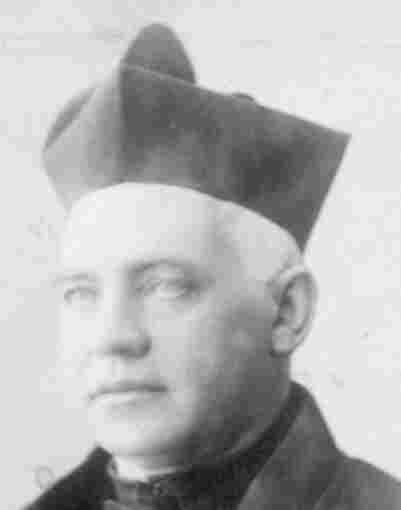
Father Vincent (Grogan) of the. Sacred Heart of Jesus.. On Wednesday 7th November of this year (1900), a telegram was received at St. Joseph1s, Retreat, Highgate, from our Retreat at Marrickville, Sidney, New South Wales, announcing the death of the Very Rev. Fr. Vincent. News had already for some months previous reached the Province that our dear Father was in failing health, but his death was not so soon expected. It was, therefore, with feelings of surprise and great sorrow that we received the news of the sad event. The Passionists of the Province, and his numerous and esteemed friends were looking forward to welcoming him home to Highgate, in the hope that he would be spared some time longer in our midst, and that he might end his days in this place, where he had laboured with so much zeal and success from the early years of his priesthood. But it has pleased God to ordain otherwise, and to call to Himself the soul of that good and holy priest at the time and in the place where, in His all-wise Providence, He knew it would be best for him and for us. By the death of Fr.. Vincent our Congregation has lost a faithful, loyal and zealous son here on earth, but gained, we confidently hope, a saint in heaven, who by his prayers and intercession will continue to assist her and her children in that work for God and for souls, which was the sole purpose of his own priestly life, and in the discharge of which he literally spent himself. Fr. Vincent was born at Croghan, in the parish of Rhode, King’s Co., Ireland, on Sept. 22nd 1837. He was the son of Peter and Catherine Grogan, and received in Baptism the name of Peter. Form his childhood he was remarkable for his serious and solid piety, and gave signs even in his early youth, of a priestly vocation, and of that life of self-denial and holiness to which he afterwards consecrated himself. After receiving the usual elementary education in the schools of his native parish, he entered St. Patrick’s College, Carlow, where he went through his classical course of studies, and afterwards his full course of Ecclesiastical studies, Philosophy, Theology, Scripture and Canon Law. The Very Rev. James B. Kavanagh, D.D., was Professor and President of Carlow College during the whole time of Fr. Vincent’s curriculum, and he used to bear testimony ever afterwards of the young student’s piety, regularity and attention to his studies. This distinguished Ecclesiastic became afterwards P.P. of Kildare, and shortly before his death he mentioned to one of the Passionist Fathers who called to see him, that on that particular day he had been looking over some his reports of the College during the time of his presidency, and paid special attention to Peter Grogan’s name. He invariably received the mark excellent for his good and exemplary conduct, and good for proficiency in his studies. At the completion of his theological studies he was ordained priest in the Cathedral at Carlow in 1864 by Most Rev. James Walshe, Bishop of Kildare and Leighlin, who to the end of his life retained a great esteem and friendship for Fr. Vincent, and who always cordially welcomed and received him at his residence, “Braganza”, Carlow, whenever the good Passionist happened to be employed, as he very often was, in giving missions and retreats in his native diocese. Immediately after his ordination, Fr. Vincent was appointed as Curate to the Rev. Joseph Murray, P.P. of Tinryland, Co. Carlow. This was the first scene of his missionary labours. During the 5 or 4 years that Fr. Vincent remained on the secular mission, he was indefatigable in all the duties of the ministry. was beloved by the He was beloved by the people amongst whom he laboured, and his memory is still cherished and revered by these good, faithful people, who corresponded so well to all his instructions and ministrations, that Fr. Vincent frequently in after life spoke of them with love and gratitude as being his joy and consolation during the time of his sacerdotal life in the world. It may be said that Fr. Vincent, humanly speaking, at this time had everything to make his life as a secular priest happy and comfortable. He had the esteem and confidence of his bishop, the love and veneration of his people, and a great field of labour for his missionary zeal. He was not, however, satisfied; he felt drawn to the religious life, and the vocation to consecrate himself to God in a religious order was strong and certain. He sought at length the permission of his bishop, who was at first unwilling to lose such an able and promising young priest. However, after some time for re- flection, recognising in his resolve and in his spirit of self renunciation, the will of God, Bishop Walsh placed no obstacles in his way and granted him the necessary permission. So soon as all his worldly affairs were settled, and the permission of his bishop duly granted, Fr. Vincent entered the Passionist novitiate in October 1867 at St. Saviour’s Retreat, Broadway, Worcs. During his novitiate, he was, though a priest in Holy Orders, one of the most humble and observant of novices. He regarded no duty as menial or disagreeable, but accommodated himself to all the humiliations, offices and mortifications of Novitiate life. He was an example to all his companions, some of whom still live and speak of his great humility and charity during his noviceship. He made his profession on the 29th October 1868, and immediately after was appointed de familia at St. Joseph’s Retreat, Highgate. For 9 years he fulfilled the office of Vice-Rector of that Retreat, and at the Provincial Chapter of the Congregation, held in 1878, was elected. Rector of the same Retreat. During his Rectorship the present monastery was completed, and through that love which he always had for the beauty of the house of God, he had the old church improved and decorated at considerable expense, the sum required having been contributed generously by the members of the congregation, who were always responsive to any call made upon their resources by their beloved Rector. In the Provincial Chapter of 1881 he was elected Provincial of the Anglo-Hibernian Province of the Congregation. In this capacity he had a larger sphere of influence for the good of the Congregation and for the good of souls, and so well did he discharge all the duties of his office and retain the confidence of his subjects and superiors, that he was re-elected Provincial in the Chapter of 1884, and. again in the Chapter of 1887. So that for 9 years he fulfilled the important and responsible office of Provincial in these countries. During those years he went before all by his virtuous and zealous example. His rule was gentle and kind,, and he retained throughout the affection and respect of all his subjects. The duties of his office were necessarily numerous and heavy, such as the visitation of the several retreats and houses of the Province; the correspondence in connection with misaions and retreats, and all matters of importance affecting the temporal and spiritual well-being of the Province and its members came under his authority. And in all he .showed himself a vigilant superior, a kind father and a prudent administrator. His zeal for the salvation of souls, however, did not allow him to confine himself to the immediate duties of the Provincialate, which may be said to be sufficient for any one man. He never relaxed his labours for the good of others. He attended the confessional, sang the late Masses on Sundays and Holydays of obligation, and took his share, and more than his share, of preaching, like any of the priests of the community; and, added to these, at regular intervals, the heavy work of giving missions and retreats. In the catalogues of missions and retreats, we find his name frequently mentioned during those 9 years, and we know what a strain upon his constitution, which was never very strong, all this work must have entailed. He was simple-minded and wise. He was self-denying and free from ambition. His sole motive of living and acting was the glory of God and the good of the Congregation. He had great ideas, in the later years of his Provincialate, of spreading the Congregation and increasing the number of Retreats. To him we owe the foundation of the Retreat and church at Herne Bay, through our most kind and generous benefactor, and Pr. Vincent’s great-friend, Mr. Frederick. A house of the Congregation was also established by him in South Wales (first at Tenby and afterwards transferred to Carmarthen, where there was a suitable church, which promises to be a very fruitful and permanent establishment for the religious and for the work of the Congregation. St. Michael’s Retreat, Wareham, was another of his foundations; but towards the end of his life Fr. Vincent must have felt that this place disappointed the zealous purpose for which the mission was founded, and, contrary to his expectation, had proved in every respect a failure so far as the work for souls and the advantage of our Congregation are concerned. In the Chapter of 1890, Fr. Gregory of St. Joseph (Callaghan), was elected Provincial, and Fr. Vincent was relieved of the burden of that office. He was chosen to the office of first Consultor Provincial. For some time his heart had been set on the Australian mission, and the spread of the Congregation in that Colony. It was while Provincial that a few Passionists, with the V. Rev. Fr. Alphonsus O’Neill, at their head, had been sent out to establish a house of the Congregation at Sidney, at the invitation of His Eminence Cardinal Moran, Archbishop of Sidney. Three houses were soon founded in Australia within the space of a few years. The V. Rev . Fr. Alphonsus was in failing health, and Fr. Vincent volunteered for that foreign mission, and took his departure for New South Wales towards the end of 1890. There he had laboured as Vice-Provincial for nearly 10 years, with the exception of 6 months when, in the years ’93 -94, he paid a visit to these countries. His life and labours out there were an exact counterpart of what we have already narrated concerning his life and labours at home, until about a year ago, when, owing to his weakened constitution, he was replaced in the office of Vice-Provincial by V. Rev. Fr. Gregory of St. Joseph, and appointed local superior of St. Brigid’s Retreat, Merrickville, where he ended his days in peace, surrounded by his religious brethren, and amongst them some faithful, dear old friends of his, such as Fr. Gregory, and that faithful lay-brother, Br. Lawrence, who acted as bis nurse and infirmarian during his last illness. From this short account of his life we may form some judgement of the character of Fr. Vincent and his life-long labours, but no words can express his wonderful influence for good over those who came into personal and friendly relations with him. To know him was to love him.. In his monastery he was the true religious, devoted to prayer, to observance and the love of Christ Crucified. His favourite devotion was that of the Stations of the Cross, and he used often relate to some of the fathers the lasting impression made on his mind, when, as a secular, he visited our church at Mt. Argus, and saw all the religious of the community joining in procession at the public service of the Way of the Cross.. In after life he would allow no duty to call him away from this devotion on Friday evenings; and no matter how tired he might be after a hard day’s work, full of care and anxiety perhaps, the congregation at Highgate would always see him taking part in this devotion. By his fervent devotion, his charity to the poor, and his zealous preaching, he enshrined himself in the hearts of that congregation in whose midst he spent the greater part of his life as a priest. They loved his apostolic preaching. He was no sounding brass or tinkling cymbal. His words not the persuasive words of human wisdom, but the words of simplicity and truth, delivered with great faith and earnestness. God blessed the labours of this apostolic missioner in a most wonderful manner, as evidenced by the great number of conversions to the Catholic Church which he was instrumental in effecting. His words of instruction and exhortation, whether spoken privately or from the pulpit, entered into the hearts of his hearers and always brought forth fruit, and will continue to bring forth fruit as long as his hearers live: and the present and future generations of the Higbgate people will have reason to praise God for the 23 years that He left His servant in their parish. It is a great privilege and & grateful duty, for one who knew him personally and most intimately, both in his private and public capacity, during his religious life, to bear testimony to his virtuous and saintly character. Holy and virtuous as hs was, there was nothing cold or austere about his virtue. He was the most open, the most single-minded, the most agreeable of companions, and the most affectionate and sincere of friends. Example and encouragement, and not domination, marked his intercourse with his subjects. No prelate in the church was more free from the spirit of lording it over those under his jurisdiction. His ceaseless study was to draw forth, to develop and apply to suitable advantage, the intellectual, moral and spiritual good qualities of his priests; and in this way, by his kind words and generous recognition, he occasioned many valuable services to religion, and maintained the good name of the congregation which he had ever at heart. He thus endeared himself to all, and on this account the hearts of all his brethren and friends are moved with the greatest sorrow and grief by the news of the death of that simple, good-natured, wise and saintly priest, who continued to the day of his death an exemplary, observant religious, and a worthy and true son of the Congregation of the Passion. At the time of writing, the particulars of his last illness and death have not reached us. From a letter written by one of his relatives in Australia, dated 26th August, we learn that Fr. Vincent was threatened at that time with paralysis. The doctors attending him told our correspondent that Fr Vincent was not the same since his last attack of a slight stroke of paralysis about two years ago; that at the time of writing both valves of the heart were affected by valvular disease and that his right side was partially paralysed. He himself complained of his hand being; powerless; one of his legs heavy and stiff; of his right side being cold, and that he felt miserable when not in the sunshine. Notwithstanding all this, we are informed that at that recent date he was able to say Mass two or three times a week, and to go to a convent some distance off to hear the confessions of the nuns every week. We think, therefore, that he had not a very long or severe last illness; and, as his whole life was a preparation for death, we may safely conclude that when his last end came, and that when he had reached that awful moment that separates time from eternity, this faithful servant of God and true son of St. Paul of the Gross, was able to say from his heart: ‘I desire to be dissolved and to be with Christ’: and that he was found worthy to hear the consoling invitation of that same loving Saviour, ‘Well done, good and faithful servant! because thou. hast been faithful over a few things , I will place thee over many things. enter thou into the joy of thy Lord.’ Signed, Arthur, C.P.