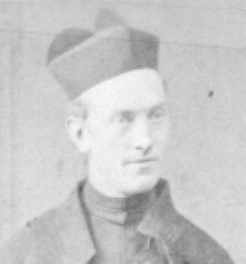
Copied from entry of 28 February, 1879, in Salvian Nardocci’s Chronicles. Death of Father Pacificus The Very Rev. Father Pacificus of the Sacred Heart of Mary, alias John Farrell, was born in Donnybrook, Dublin on 14 September, 1837. Was clothed with our holy habit on 9 October, 1865, and again on 28 October, 1867. The first time was clothed as a Lay Brother, and the second as a clerk. Made his profession on 29 October, 1868, and died on 28 February, 1879, in St. Paul’s Retreat, Mt. Argus, being Rector of Holy Cross, Belfast. The good Father had been sent to Dublin in the hope that by the skilful attendance of the best Doctors, and under the care of our infirmarian, he would be spared to us, but God disposed otherwise. Father Pacificus was an excellent missioner, and a saintly good Passionist. R.I.P. To give some idea of his life we cannot do better than to copy here the leading article of the Irish Daily News, dated March 5th, communicated to said paper by our own Fathers. Dublin, Wednesday, March 5th. “A very noteworthy person has just passed away from our midst; a person whose brief career, well deserves the attention of men of all classes and creeds. His claim to distinction rests not on military prowess, or success in the Senate, or the courts of law. His merit, albeit conspicuous, was of a very different kind. The message of doom came to him, not amidst the glorious terrors of the battlefield, but in the House of God, pleading for friendless outcasts, literally yielding up his life in a struggle for mercy. His record of service was a short one, but it was one unceasing effort for the good of his fellow men, who are engaged in the vortex of this world’s cares, to strengthen them against the temptations and snares which so perpetually beset them, to raise them above the sordid pursuits in which their avocations so often entangle them, and to guide them to the higher life which we can all admire as an ideal, but which seems so hard to embrace, and which it was his object to show was within the reach of all. His name was unheard among the haunts of fashion. But it was well known and loved among the young men of our city, especially those engaged in business, and among the poor. And not in Dublin only, but in Newry, Belfast, Glasgow, and all the great centres of population. For he was no solitary recluse, although his life ended in a humble cell, at the House of the Passionist community at Mt. Argus (where he had spent many years). “The Rev. John Farrell, or Father Pacificus, as he was called among the religious brotherhood, who leave even their names behind them when they embrace their new method of life, came of a Wexford family, and was born in 1837. He was always studious and serious youth, inclined to exercises of piety. “In early manhood he was a member of a commercial firm, owners of a thriving concern in Wexford Street, in this city. When Pius IX entrusted to Lamoriciere the task of reorganising the Pontifical army, young O’Farrell volunteered, with hundreds of others, to take service under the Papal Banner. (This took place after he had left the Novitiate the first time, with the advice of his Superiors, that he might learn well Latin, and be received as clerk.) He was present at the fatal battle of Castelfidardo, when Lamoriciere expressed his admiration for the valour, discipline and fire displayed by the handful of Irish recruits, and was included in the capitulation of Ancona. “Upon his return to Ireland he rejoined his partner, and displayed an attention to business, as if business prosperity was the great aim of his life. But to his intimate friends it was evident that his wishes were very different, and that the tendencies of his boyhood were likely to have their legitimate result. (After closing the business in the evening, he attended Latin class under the direction of Prof. Campbell C.U.) Soldiering had made him the very reverse of a “roistering blade” and the earnestness with which he had hastened to defend the temporal rights of the Holy See, was only a pledge of the devotedness with which he would labour in the spiritual service of the Church. “It was soon known that he desired to entered the ministry, and for this purpose he resumed the studies which had been for years laid aside. After some time his desire was so far gratified that he was admitted into the Novitiate of the Passion, in Broadway, Worcestershire. But after few months his health completely broke down, and he had to quit Fayle, his Superiors recommending him to content himself with leading a Christian life, while engaged in business pursuits, for he would never be able to pass through the probationary period preliminary to the priesthood. (His novice master, who knew him “intus et foris” advised him to study well Latin, and apply again to enter as a cleric.) “John Farrell submitted himself to the directions, returned again to his partner, who cheerfully received him, attended to his business, continued his studies, and rapidly recovered his health. (After this he joined the Papal Army. Before returning to Ireland, having met our Father Vincent Grotti, who had known Mr Farrell in Dublin, encouraged him to perfect himself in the Latin language, and then apply to the Provincial to be readmitted.) After an interval of about a year, he applied to the Passionist Provincial, who received him, and on 20 October, 1867, he was clothed again as cleric. He was ordained priest in 1873. Thenceforward his life was incessant toil, devoted to preaching, hearing confessions, and other duties connected with missions. It was thus that Father Pacificus spent the last five years of his life. He was engaged in missions at Manchester, at Liverpool, at Derry, Glasgow, Swansea, Ballina, Newry, Belfast, Dublin, and many other places, and when not actually occupied in a mission, it was almost certain that he would be found preaching, or in the confessional. His eloquence was not of a high, or very cultivated order. Perhaps it’s unpolished simplicity was his great charm; it certainly went home to the hearts of his audiences. Witness the affectionate veneration in which he was held by the poor, for whose trials and privations he had ever the deepest sympathy, and who testified their sorrowful feeling for his loss, as they gathered around his bier at Mount Argus. “The subjects upon which he preferred to preach were the duties of a Christian. He particularly addressed himself to the young men, and especially to those engaged in business, or belonging to the artisan class. He inculcated with words of simple, but almost passionate earnestness, the practise of humility, and of respect for superiors, continence and sobriety, honesty in their dealings, all eminently virtues most fitting to their station in life. In a certain sense he was almost an apostle of young men. He exerted himself in every way to facilitate their going to confession. He extended his watchfulness to their after careers, when they went away to other places, putting them “en rapport” with some zealous priest, and inducing them to correspond with himself. “He had indeed a host of correspondents, some of them as remote as in America. Who will deny that this humble, zealous worker in the vineyard, achieved much good, both spiritual and social, by his self-sacrificing exertions? About three years ago, while engaged on a mission, he got a severe wetting, and with that marvellous imprudence which seems a parasite of the clerical profession, he remained for some hours in his wet clothes. From this he contracted a very painful form of rheumatism, which gradually affected some of his internal organs, causing intense suffering. “Several months ago, he was warned by the medical advisers that he must give himself complete rest, if there was to be even a chance of continuing his career of usefulness. But rest for him was impossible; it would have seemed to him like wilful neglect of duty. So long as he could make his voice heard, so long as he could sit in the confessional, so long he considered himself bound to work. “Last Christmas, in the midst of the terribly severe weather, he came from Belfast to Dublin, and preached in the church of Westland role, a most pathetic appeal on behalf of the Magdalen asylum, Donnie Brooke. It was his last sermon. He had preached against the absolute prohibition of his Dr. The cold weather, combined with the exertion, was too much for him, and he was at once prostrated with what proved to be his last illness. Not all at once was he confined to his bed; but it was with the utmost difficulty that he was restrained from hearing confessions. “Indeed we have been informed that his ecclesiastical superiors had distinctly to forbid him to exercise any functions. Surely the preacher stricken while his voice is raised in the cause of charity, falls as truly on the “Champ d’honneur” as the soldier whom a hostile bullet sends to his last account. “Last Friday evening he was released from his sufferings, and went we may trust to receive the award of a life of most unselfish devotedness to the religious improvement of his fellow men. By his death the Passionist order has lost a most excellent member, and the church has been deprived of a zealous and untiring missionary. Surveying the record of his short, but fruitful career, we cannot but feel how little the world knows of some of the most useful lives that are spent amongst us. The work wrought by Father Pacificus reminds us that there are doubtless many others like him, intent solely on winning men to lead a Christian life, doing, we might almost say “good by stealth” so noiselessly do they labour. It is well for the world that it so often “entertains an angel unawares.” Theories of philosophers are very fine pieces of reasoning no doubt, and may answer for those who are not tempted by hard want to wander from the safe path. But for the poor man, for the humbler classes pinched by want, and almost challenged to assail those better off than themselves by the cold disdain with which their requests are often rejected, the Christian Gospel is now, as centuries ago, the only real solace and safeguard. In the midst of civilisation of the nineteenth-century, as in the rude life of the middle ages, and the effeminacy of the decaying Roman Empire, the message which bids man bear the sufferings of this life patiently, and to look for consolation beyond the grave, is the real sheet-anchor of humanity. And the enthusiastic men who preach that “Gospel to the poor” are the greatest, and most lasting benefactors of society.. The funeral obsequies were celebrated on 3 March, in the presence of a crowded congregation, but especially of the young men of the city and the surrounding country; some of them came from Belfast, Newry, and other places where the deceased was well known. He was buried in our little cemetery, close to the church of St. Paul, Mt. Argus.