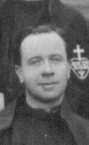
Father Stanislaus Curran, C.P. THERE is surely no word, but consternation to express the feelings with which his brethren and friends heard the sad news of the death of Father Stanislaus Curran on the morning of the 22nd of November. His illness was of the briefest. Hardly anyone outside of his own small community in Belfast knew that he had been stricken down. And the announcement of his serious illness, which came with something of a shock to other communities of his brethren, was followed an hour or so later by the announcement of his death. No details have so far reached us beyond the fact that he fell a victim to the plague which is taking such ruthless toll of the humanity which war has ceased to ravage. His loss will be felt bitterly and long by many, but by none more than his brethren of the Congregation of the Passion, of which he was so brilliant and devoted a member. Father Stanislaus, who had not yet reached his forty-seventh year, was one of an Irish family whose character is best shown in the fact that most of its children. have devoted themselves to the service of God in the religious life. Two of his brothers are priests of the Redemptorist Order, one – Father Richard – is a Passionist, while two of his sisters are nuns. Attracted to the Congregation of the Passion himself, he made his profession on September 13th, 1893, and so had just completed his twenty-fifth year as a Passionist. After a brilliant course of Philosophy and Theology at Mount Argus in preparation for the priesthood, he was ordained to the sacred ministry at the Pro-Cathedral, Marlborough Street, on the 4th of June,1898, by His Grace, the present Archbishop of Dublin. His work during the early years of his priesthood lay in London, where he became. well known as a preacher, and was instrumental in making many ‘Converts to the Faith. For several years subsequently he was engaged at Mount Argus in teaching Theology, an office for which his clear intellect, his wide reading, his sure and comprehensive grasp of his subject, and. his fine powers of exposition gave him a special aptitude. But neither then nor in after years was his work confined to teaching. His versatility was unusual, and he was no niggard when any call was made upon hid powers. He was not less notable as a preacher than as a teacher, and whether in giving missions to the faithful or retreats to, religious communities, or preaching charity sermons, or giving courses of lectures, he was equally sought after and equally successful. It was seldom that his powers were not in request in one or other of these ways, and even when not his time was well accounted for by his parochial duties and his work among the poor during the many years he spent on the English mission, as well as by the multitudinous calls unfailingly made on one of his zeal and charity. His capacity for work, indeed, seemed endless; and though once or twice in later years his health broke down under the strain, the return of strength meant for him only a resumption of his labours with increasing ardour. Readers of this magazine will not need to be reminded of his distinction as a writer. For years he was a constant contributor to these pages, and indeed his facile and eloquent pen was one of the strongest supports of this periodical in days when strong support was a vital necessity. He could always be relied on for literary aid, and often at the shortest notice would produce an article equally gratifying to editor and reader. One of the regrets of those who knew him best will be that his busy and various life did not permit of his leaving behind him in enduring form something of the literary work which he had it undoubtedly in him to produce. But his zeal for souls and his charitable activities left him little leisure, and perhaps after all the medium in which his work was of necessity done would have been his for choice – the souls of men. His loss to the Congregation of which he was a member will be a heavy one, and his place in its ranks will not easily be filled. Many to whom his frank, homely, genial disposition endeared him, many who came under the spell of his eloquence in the pulpit or the spell of his influence in the confessional – and all felt him a friend – will be conscious of a great void in their lives now that he has gone. The claim he has established on their gratitude will, we trust, not be forgotten, and their prayers will follow him so that his enjoyment of the eternal wage he has won by his life of labour in the vineyard of Christ may not long be delayed. May Our Blessed Lady, to whom he had a tender devotion, whose sorrows and glories he loved to preach, and with the passing of whose great feast he passed away, obtain a high place for his soul in the Kingdom of her Son. Ar dheis De go raibh a anam.. (Cross, Vol. IX, 1918-19; pp. 229f.) Father Stanislaus Curran, C.P. The tidings of the death of Fr. Stanislaus must have caused no little astonishment in the Province of St. Joseph. In the beginning of his illness none of his brethren suspected that within the short space of a week his soul would have returned to the hands of his Creator. On November 13th, the day following his feast day, he accompanied the students on a long walk. The day was very cold and it is feared that Fr. Stanislaus contracted a chill: but his untiring energy and his anxiety for the progress of the students did not permit him to remain confined to his room. He continued his duties as Lector, and on Saturday evening attended the confessional. On Sunday morning during his preparations for Mass, he became so weak that he had to refrain from offering the Holy Sacrifice. He returned to bed, but his condition gave no grounds for anxiety. On Monday, however, he gradually became worse, and on Tuesday evening on the advice of the doctor, he was sent to St. John’s Private Hospital. To some of his brethren who visited him on Wednesday morning, he seemed in the best of spirits, and expressed the hope that he would be able to leave the hospital in a few days. On the morning of the following day (Thursday) a change for the worse took place. As the day advanced it was evident that the dread disease was gaining the mastery over him hour by hour, and it was thought advisable to administer to him the last Sacraments, which he received with edifying fervour. All the efforts of medical skill and nursing were unavailable, and late on Thursday evening he lost consciousness, and remained in this state until the end, which took place on Friday morning at 1.30. Father Bernard, the Rector, Father Richard, his brother, and Father Justin were present when he breathed forth his soul into the hands of his maker. Father Stanislaus had just completed his twenty-fifth year as a Passionist, being professed on September, 13th., 1893. After a brilliant course he was raised to the dignity of the priesthood on 4th June, 1889, by His Grace, Most Rev. Dr. Walsh. For some time after his ordination he was stationed in London where his abilities were recognised and his services frequently called into requisition. Subsequently he was transferred to Mount Argus to undertake the duties of Lector, a position for which he was unusually suited. The latter years of his life were spent on the English Mission, where he did much by his eloquent preaching to dispel the clouds of error and heresy: and his efforts as a labourer in the missionary field were crowned with great glory. With the death of Father Stanislaus God has repeated the lesson which he has taught us so often before, “Remember, man, thou art but dust, and unto dust thou shalt return”, and in his case a most forceful emphasis has been given to the wording. His death was a fitting termination to his exemplary life, and the community of Holy Cross are consoled in their affliction by the circumstances that attended the last hours of his priestly career. At the coming of our Blessed Lord, he was found prepared like the wise virgins in the Gospel, with his lamp well trimmed and burning brightly in his hand. He was strengthened in his last agony not only by the sacraments of the Church, but also by the discipline and influence of a good and well ordered life. His Lordship, the Most Rev. Dr.McRory, Bishop of Down and Connor, presided at the obsequies, at which were present a very large number of clergy. Bernard, C.P., Rector.