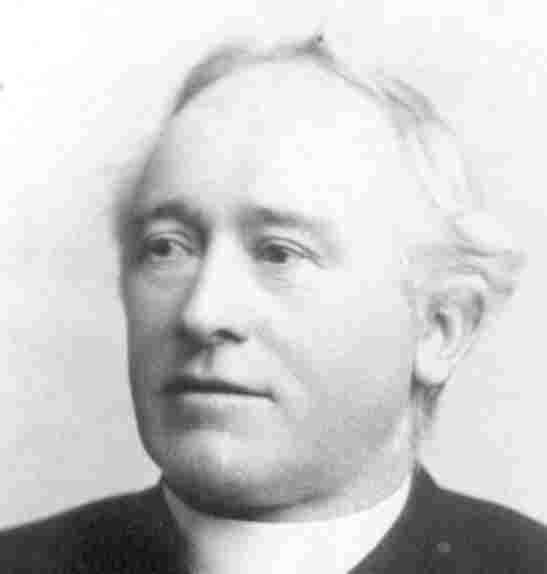
The late Father Gregory Callaghan, Ex-Provincial. The festival of our Holy Founder was this year clouded by a great sorrow up for the religious of our Province, the passing away from them, by of holy death, to his eternal reward, of the revered and much loved father Gregory Callaghan. A long and wasting illness suddenly drew near its conclusion, as the festival was being celebrated, and before its close Father Gregory had breathed his last, as though our Holy founder had claimed, as part of his joy in the day, the happy release from the sorrows of the earth of one who had most faithfully followed Him in the love and service of the Crucified. Father Gregory of St Joseph, whose secular name was John Patrick Callaghan, was born at Strokestown, County Roscommon, on the 21st March, 1843, but soon after his birth the family migrated to Dublin, where he received his early education at a classical school conducted by the late Bishop Grimley, then a curate in St Paul’s parish in that city. In those years he was distinguished by a marked spirit of piety, which developed into a religious vocation, and drew him to our Congregation. He received the habit at St Saviour’s, Broadway, on the April 16th, 1862, and made his Novitiate under the late Reverend Father Salvian. Professed in the following year, he made his ecclesiastical studies at St Paul’s Retreat, Dublin, and in due time was ordained priest in the Carmelite Church, Whitefriar Street, by Bishop Whelan, of Bombay. The first years of his priesthood were passed in our houses of Paris and London; afterwards at St Anne’s, Sutton, where he had charge of the district attached to that retreat. While he entered zealously into these labours of the Ministry, high above his unselfishness and zeal for the salvation of souls shone that love for the Rule and observance, which was a strong characteristic of his whole life. This union of happy qualities soon gained for him a wide respect and confidence, and he fulfilled the offices, first of Rector of St Saviour’s, Broadway, then of Saint Joseph’s, Highgate, and in the Chapter of 1887 he was elected Master of Novices. But this he held for only about half the appointed time, for, at the request of the higher superiors, he resigned to accept the heavy charge of St Paul’s Retreat, Dublin, at a time of the many difficulties. At the next Chapter, in 1890, he was elected Provincial, an office to which he was twice re-elected. His nine years rule of the Province was eminently characteristic of the man. Kind and considerate to the religious, he was, “as in the least amongst them,” wise and strenuous in the duties of his office, in the Rule and observance most vigilant, and leading by the power of saintly example. In 1899, being First Consultor, he went to Australia as a representative of the Provincial. While there, besides his care of the three young and struggling Retreats, he laboured zealously on missions and retreats – indeed, beyond his strength, for it was while giving a mission in the diocese of Goulburn that he was stricken with paralysis – an attack from which he never completely recovered. Returning home, his native air seemed to promise recovery, and once more he devoted himself to the labours of the ministry in these countries. In his readiness to do whatever good lay to hand, he accepted, for a time, the charge of St Joseph’s, Highgate, and, in the Chapter of 1905, he was elected, and, at the earnest prayers of the Fathers, undertook once more the Office of Master of Novices. But his increasing disability forced the superiors to accept his resignation, and, in the hope that his native air might yet effect some good to his health, he was sent to St Paul’s Retreat, Dublin. There, in weakness each day growing, his love for observance still shone, to the edification of all, while he also attempted to labour in the cause of Jesus Crucified by attending the confessional in the Church as long as this was possible to him. But the malady which had come upon him in Australia gradually advanced, ending in a long illness, borne with the gentlest patience and complete resignation to the Divine Will, and fitly ending in a peaceful death, amid the prayers of his brethren, on the festival of our Holy Founder. To Father Gregory was given a long life in the Congregation, and through all of it his earnest piety, fidelity to observance, and generous labours won him the respect and love of his brethren. If his years were fruitful of much good, it was not owing to any very great natural gifts, but first, of course, to his correspondence with grace, which led him from boyhood along the path of innocence and prayer to the maturer holiness of the fervent religious, the zealous missionary, the vigilant superior. When he was in the novitiate he said to a brother novice that he “came to give his life to the Congregation”; that purpose he nobly fulfilled. To all the religious of this Province, that he loved so well, and served so faithfully, his life was a lesson and a help, and now that God has called him from us, while our prayers for his sold must still follow him, we have the confident hope that his reward is exceeding great, and the knowledge that he will still remember and pray for us. (Cross, Vol. II, 1911-12; pp. 67ff.)